📌 What You Need to Know in a Nutshell
- Urological cancers are the most common group of cancers in men; prostate cancer ranks second among men in Turkey.
- The 5-year survival rate for early-stage prostate cancer is 99%; for bladder cancer, this rate is 77% with early diagnosis.
- Testicular cancer is the most common cancer among men aged 15–40, and the 5-year survival rate in early stages is over 95%.
- Immunotherapy and targeted therapies can increase survival by 20–40% in advanced-stage kidney and bladder cancer.
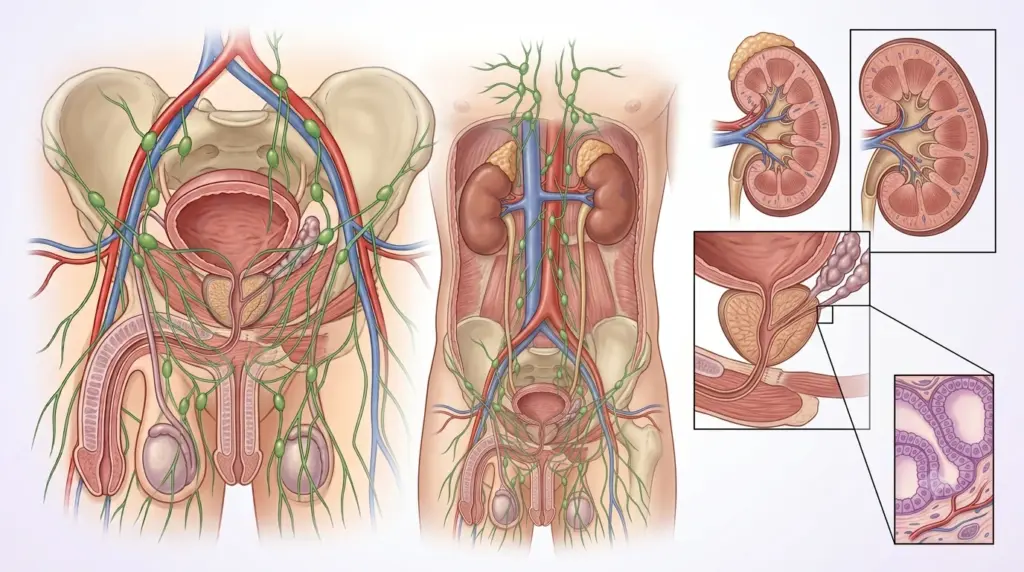
Urological cancers refer to malignant tumors affecting the urinary tract and male reproductive organs. This group includes prostate, bladder, kidney, and testicular cancers. Millions of new cases are diagnosed worldwide each year, and treatment success rates are high when intervention occurs in the early stages.
What Are Urological Cancers?
Urological cancers are a category of cancers that include malignant neoplasms developing in the urinary tract and male reproductive organs. The four most common types in this group are prostate cancer, bladder cancer, kidney cancer, and testicular cancer. Each has distinct causes, risk factors, and clinical course.
According to data from the International Agency for Research on Cancer (IARC), prostate cancer ranks second among the most common cancers in men in Turkey, with 17,274 new cases, while bladder cancer ranks fourth, with 11,168 cases. Kidney cancer, with 5,400 new cases, accounts for approximately 2.3% of all cancers.
According to Assoc. Prof. Dr. Nilay Şengül, the most critical factor in the diagnosis and treatment of urological cancers is adopting a personalized approach based on the patient’s individual risk profile. Genetic profiling and molecular diagnostic methods are becoming increasingly important in determining which patients require aggressive treatment and which can be monitored through active surveillance.
Types of Urological Cancers
Prostate Cancer
Prostate cancer is the most common urological cancer in men. According to IARC GLOBOCAN 2022 data, 17,274 new cases are diagnosed annually in Turkey, accounting for 13% of all cancers in men. Incidence increases with age; the median age at diagnosis is 68.
Risk factors include advanced age, family history, African American ethnicity, and obesity. PSA (Prostate-Specific Antigen) screening plays a key role in early diagnosis; according to clinical trial data, PSA screening in men aged 55–69 can reduce the risk of prostate cancer-related death by up to 20%.
Bladder Cancer
Bladder cancer originates in the cells of the inner lining of the bladder. It is the fourth most common cancer among men in Turkey. Smoking is the primary preventable risk factor, accounting for approximately half of all bladder cancer cases. The 5-year survival rate is 77% for patients diagnosed with early-stage bladder cancer, while this rate drops to 5% in advanced stages.
Kidney Cancer
Kidney cancer, also known as renal cell carcinoma (RCC), originates in the kidney parenchyma. Its incidence has been increasing by 2% annually over the past decade; this increase is thought to be largely due to an increase in incidental diagnoses resulting from the widespread use of imaging techniques. It is 1.5 times more common in men than in women. The 5-year survival rate for patients diagnosed at an early stage is 93%.
Testicular Cancer
Although testicular cancer accounts for only 1–2% of all cancers, it is the most common cancer among healthy men aged 15–40. Its incidence has been reported as 4–8 per 100,000. Germ cell tumors (GCTs) account for 90–95% of testicular cancers. When diagnosed and treated in the early stages, the 5-year survival rate exceeds 95%.
| Cancer Type | Annual New Cases in Turkey (2022) | Male-to-Female Ratio | Early-Stage 5-Year Survival Rate |
|---|---|---|---|
| Prostate | 17,274 | Men Only | 99 |
| Bladder | 11,168 (men) | 3:1 | 77% |
| Kidney | 5,400 | 1.5:1 | 93% |
| Testes | N/A (rare) | Males only | 95%+ |
Symptoms and Risk Factors
The symptoms of urological cancers vary depending on the tumor’s location and stage. However, there are some common warning signs:
- Blood in the urine (hematuria) — the most common symptom of bladder and kidney cancers
- Frequent urge to urinate or pain/a burning sensation during urination
- Pain in the lower back or groin
- A firm, painless lump or swelling in the testicle
- Enlarged lymph nodes in the groin
- Weight loss, fatigue, and night sweats (advanced stage)
Risk factors vary depending on the type of cancer:
| Risk Factor | Affected Cancers | Relative Risk Increase |
|---|---|---|
| Smoking | Bladder, kidney | Bladder: ~2–4 times |
| Obesity | Kidney, Aggressive Prostate Cancer | Kidney: ~1.5–2 times |
| Family history | Prostate, kidney | Prostate: ~2–3 times |
| Advanced age (>50) | Prostate, bladder, kidney | Increases with age |
| Undescended testis (cryptorchidism) | Testis | ~3–5 times |
Urological Cancers and Their Treatment
The treatment of urological cancers is tailored to the individual based on the tumor’s histological type, stage, the patient’s age, and any comorbidities. In modern oncology, surgery, systemic therapies, and radiation therapy are evaluated together.
Surgical Treatments
Radical prostatectomy is the gold standard surgical method for localized prostate cancer. Open, laparoscopic, and robotic approaches may be used. Robotic surgery offers the advantages of less bleeding, a shorter hospital stay, and faster recovery.
Radical nephrectomy aims to remove the tumor and surrounding tissues in kidney cancer. Today, nephron-sparing surgery (partial nephrectomy) is preferred in suitable patients to preserve kidney function.
Radical cystectomy is the surgical removal of the entire bladder in cases of invasive bladder cancer. In male patients, the prostate and seminal vesicles are also removed. An ileal conduit or a neobladder may be created as a urinary diversion.
Orchiectomy is the removal of the testis, performed for both diagnostic and therapeutic purposes in testicular cancer. Following this procedure, retroperitoneal lymph node dissection or chemotherapy may be planned.
Systemic Therapies
Immunotherapy is a treatment approach that activates the immune system to target tumor cells. PD-1/PD-L1 inhibitors (pembrolizumab, nivolumab) and CTLA-4 inhibitors (ipilimumab) are among the standard treatment options for advanced-stage kidney and bladder cancer. In clinical trials, immunotherapy has been shown to increase survival by 20–40% in advanced kidney cancer.
Targeted therapies are drugs that target the molecular structure of the tumor. In kidney cancer, VEGF inhibitors (sunitinib, pazopanib) and mTOR inhibitors (everolimus) are used. In prostate cancer, androgen receptor inhibitors (enzalutamide, abiraterone) and PARP inhibitors (olaparib) have demonstrated efficacy.
Chemotherapy is the primary treatment modality that achieves high success rates in testicular cancer. The BEP (bleomycin, etoposide, cisplatin) regimen is the standard chemotherapy regimen for germ cell tumors. In advanced-stage bladder cancer, the gemcitabine plus cisplatin combination is widely used.
Radiation Therapy
External beam radiation therapy can be used as an alternative to surgery or as adjuvant therapy in localized prostate cancer. Brachytherapy (internal radiation therapy) can be used alone or in combination with external beam radiation therapy in low-risk prostate cancer. Lutetium-177-PSMA (Lu-177-PSMA) peptide receptor radionuclide therapy is used as a targeted internal radiation therapy for metastatic castration-resistant prostate cancer.
Clinical Assessment by Assoc. Prof. Dr. Nilay Şengül
In my clinical practice, I frequently observe the following: Most urological cancers, particularly prostate and kidney cancers, are incidentally detected during imaging studies performed for other reasons. This situation increases early-stage diagnosis rates and positively impacts treatment outcomes.
According to Assoc. Prof. Dr. Nilay Şengül, the most significant paradigm shift in the treatment of urological cancers is the transition from a “one-size-fits-all” approach to “personalized treatment based on molecular profiling.” The genetic profiling tests we perform at Memorial Şişli Hospital enable us to predict which patients will respond to immunotherapy and which to targeted therapies. This approach increases efficacy while reducing the burden of unnecessary treatment.
In particular, the combination of PSMA-PET imaging and Lu-177-PSMA therapy has become an important part of our clinical practice in recent years, especially for advanced prostate cancer. This treatment significantly improves both quality of life and survival in patients with metastatic disease.
From Diagnosis to Recovery: How Does the Process Proceed?
- Initial Examination and Evaluation: The patient’s symptoms, family history, and lifestyle are thoroughly assessed. During the physical examination, a digital rectal exam is performed to examine the prostate, and palpation is performed to examine the testicles. Assoc. Prof. Dr. Şengül emphasizes that listening to the patient’s concerns during the initial consultation increases treatment adherence in her clinical practice.
- Tests and Imaging:
- Blood Tests: PSA (prostate), LDH, AFP, beta-hCG (testes), complete blood count, biochemistry
- Imaging: Pelvic MRI (prostate), CT urography (kidneys, bladder), PSMA-PET (advanced-stage prostate), chest CT (metastasis screening)
- Invasive Diagnosis: Transrectal ultrasound-guided prostate biopsy, cystoscopy-guided bladder biopsy, testicular biopsy (via orchiectomy)
- Staging and Treatment Planning: The extent of tumor spread is determined using the TNM staging system. An individualized treatment plan is developed during a multidisciplinary tumor board meeting (medical oncology, radiation oncology, urology, pathology, radiology).
- Treatment Implementation:
- Surgery: Hospital stay is 1–5 days, depending on the procedure
- Chemotherapy: Typically administered in 3- to 4-week cycles, for a total of 4 to 6 cycles
- Immunotherapy: Administered at 2–3-week intervals, long-term
- Radiation Therapy: Daily fractions, totaling 4–8 weeks
- Discharge and Recovery: The hospital stay following surgery is typically 1–2 days for robotic prostatectomy and about 5–7 days for radical cystectomy. Same-day discharge is usually possible after orchiectomy for testicular cancer.
- Follow-up and Monitoring: Follow-up appointments are scheduled every 3 months for the first 2 years, every 6 months for the next 3 years, and annually starting in the 5th year. PSA monitoring (prostate), imaging (kidneys, bladder), and marker monitoring (testes) are performed routinely.
Frequently Asked Questions
Does prostate cancer always need to be treated?
No. For low-risk, localized prostate cancer, active surveillance is a safe and well-established approach. This strategy involves monitoring the patient through regular PSA testing and biopsies, with treatment initiated only when necessary. Clinical studies have shown no difference in 10-year survival rates between active surveillance and early intervention.
I noticed blood in my urine—does this necessarily mean cancer?
Blood in the urine (hematuria) does not always indicate cancer. Kidney stones, urinary tract infections, an enlarged prostate, and glomerular diseases can also cause hematuria. However, visible hematuria in men over 40 and in smokers should be evaluated for bladder cancer. Cystoscopy and imaging tests are required for a definitive diagnosis.
Is it possible to have children after testicular cancer treatment?
Yes, it is possible. The remaining testicle may continue to produce sperm after a unilateral orchiectomy. However, chemotherapy and radiation therapy may temporarily or permanently affect sperm count and quality. For this reason, sperm freezing (sperm cryopreservation) is recommended before treatment. It may take 2–5 years for sperm count to return to normal after treatment.
How effective is immunotherapy for urological cancers?
Immunotherapy has become the standard of care for advanced-stage kidney and bladder cancers. In kidney cancer, the combination of pembrolizumab and axitinib has increased overall survival by 30–40% compared to targeted therapy alone. In bladder cancer, immunotherapy has also demonstrated efficacy in disease that has progressed after platinum-based chemotherapy. In prostate cancer, however, its indications are currently limited.
Is robotic surgery better than open surgery?
Robotic surgery offers the advantages of less bleeding, a shorter hospital stay, and faster recovery compared to open surgery. However, it yields equivalent results in terms of long-term cancer control and urinary incontinence/erectile dysfunction. The most appropriate surgical approach for each patient is determined based on the tumor stage, the surgeon’s experience, and the patient’s anatomical characteristics.
Urological cancers are a group of cancers for which high treatment success rates can be achieved through early diagnosis and modern treatment approaches. Different treatment strategies are used for prostate, bladder, kidney, and testicular cancers; these strategies include surgery, systemic therapies, and radiation therapy. Personalized medicine and molecular profiling play a critical role in determining which patients will benefit most from which treatment.
To discuss your specific situation regarding urological cancers and have your questions answered, you can consult with Assoc. Prof. Dr. Nilay Şengül. To schedule an appointment at her clinic at Memorial Şişli Hospital, please call 444 7 888.
References
- Sung H, Ferlay J, Siegel RL, et al., CA: A Cancer Journal for Clinicians, 2021 — "Global Cancer Statistics 2020: GLOBOCAN Estimates of Incidence and Mortality Worldwide for 36 Cancers in 185 Countries" — https://pmc.ncbi.nlm.nih.gov/articles/PMC7808760/
- American Cancer Society, 2024 — "Cancer Facts & Figures 2024" — https://www.cancer.org/content/dam/cancer-org/research/cancer-facts-and-statistics/annual-cancer-facts-and-figures/2024/2024-cancer-facts-and-figures-acs.pdf
- European Association of Urology, 2024 — "EAU Guidelines on Prostate Cancer" — https://uroweb.org/guidelines/prostate-cancer
- Turkish Urological Association, 2025 — "Urological Oncology Bulletin, Volume 9, Issue 1" — https://www.turolojidernegi.org.tr/ (No direct link to the journal issue was found; redirected to the association’s homepage)
- Motzer RJ, et al., New England Journal of Medicine, 2019 — "Pembrolizumab plus Axitinib versus Sunitinib for Advanced Renal-Cell Carcinoma" — https://www.nejm.org/doi/full/10.1056/NEJMoa1816714
- WHO/IARC, GLOBOCAN 2022 — "Turkey Cancer Statistics 2022" — https://gco.iarc.fr/today/data/factsheets/populations/792-turkey-fact-sheet.pdf
- World Health Organization (WHO), International Agency for Research on Cancer (IARC). Cancer Statistics for Turkey 2022. GLOBOCAN 2022 Fact Sheet.