📌 What You Need to Know in a Nutshell
- Stomach cancer results from the uncontrolled proliferation of glandular epithelial cells in the stomach lining; approximately 1 million new cases are diagnosed worldwide each year.
- In localized disease, the 5-year survival rate is 78.1%; it drops to 39.0% in regionally advanced disease and to 8.1% in metastatic disease.
- In patients with PD-L1 CPS ≥5 in metastatic patients, nivolumab plus chemotherapy extends median survival to 14.4 months (vs. 11.1 months) compared to chemotherapy alone; the 4-year survival rate reaches %17.
- Helicobacter pylori infection is the most important modifiable risk factor for stomach cancer; eradication therapy reduces the risk.
Stomach cancer is a malignant neoplasm originating from the glandular epithelial cells of the stomach mucosa. Worldwide, approximately 1 million new cases are diagnosed, and more than 768,000 deaths occur. The disease is twice as common in men than in women and has the highest incidence in the 55–74 age group. Histologically, adenocarcinoma (95%) is the most common subtype; according to the Lauren classification, there are two main subtypes: intestinal and diffuse.
What Is Stomach Cancer?
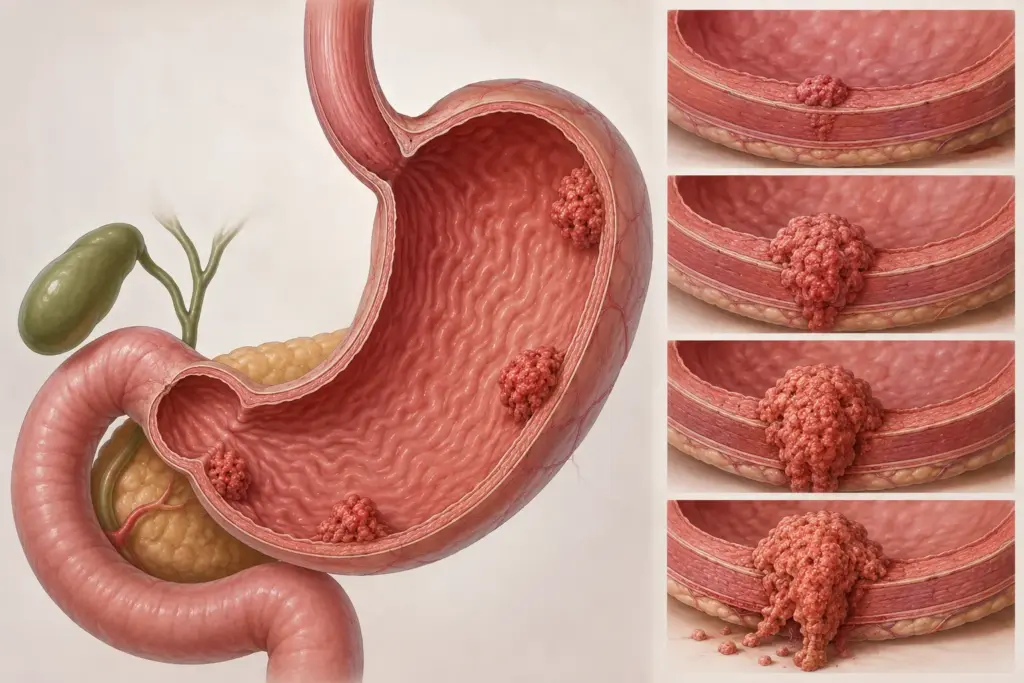
Stomach cancer is a malignant tumor resulting from the uncontrolled growth of glandular epithelial cells in the stomach mucosa. Approximately 95% of cases are adenocarcinomas; other rare types include lymphoma, gastrointestinal stromal tumors (GIST), and neuroendocrine tumors. According to the Lauren classification, the intestinal type (50–60%) and the diffuse type (30–40%). The intestinal type is associated with Helicobacter pylori infection, diet, and lifestyle; the diffuse type is associated with genetic factors and CDH1 gene mutations.
The development of stomach cancer is mostly a step-by-step process known as the Correa cascade: normal mucosa → chronic gastritis → atrophy → intestinal metaplasia → dysplasia → invasive carcinoma. This process takes an average of 10–20 years. Tumor location is also important in terms of prognosis; gastroesophageal junction (GEJ) tumors behave similarly to esophageal cancer, whereas tumors of the gastric body and antrum exhibit different biological characteristics.
Molecular subtyping also plays a critical role in treatment selection. HER2 positivity (15–20%), MSI-H/dMMR (5–10%), and EBV positivity (8–10%) guide treatment selection. In particular, trastuzumab plus chemotherapy is the standard first-line treatment for HER2-positive metastatic patients; according to the KEYNOTE-811 study, the addition of pembrolizumab increased the ORR from 47% to 74%.
Symptoms of Stomach Cancer
Symptoms of stomach cancer vary depending on the stage and tumor location. In the early stages, 60–80% of patients are asymptomatic, or their symptoms may be mistaken for benign stomach conditions. The most common symptoms in symptomatic patients are as follows:
- Epigastric pain or discomfort: Constant or intermittent pain in the upper abdomen; this is the most common symptom but can be confused with benign dyspepsia.
- Feeling of early satiety: A feeling of fullness after eating only a small amount of food; this results from the tumor reducing the stomach’s capacity.
- Bloating and gas: Abdominal bloating and gas accumulation after meals.
- Nausea and vomiting: May develop as a result of obstruction, particularly in tumors of the pyloric region.
- Unintentional weight loss: Loss of more than 5% of body weight in the last 6 months.
- Occult or overt bleeding: Melena (black, tarry stools) or hematemesis (vomiting blood); leads to iron deficiency anemia.
- Fatigue and anemia: Iron-deficiency anemia resulting from chronic occult bleeding; hemoglobin levels <11 g/dL are of particular concern.
Emergency symptoms are also present. Complete gastric outlet obstruction (projectile vomiting, bloating), perforation (acute abdominal pain, peritonitis), or severe bleeding (hemodynamic instability) may require emergency surgery. The mortality rate is high in these cases.
Stage 1 Stomach Cancer Symptoms
Symptoms of stage 1 stomach cancer are generally mild or nonspecific. Most patients are asymptomatic at this stage. In patients who do experience symptoms, mild epigastric discomfort, belching, mild nausea, and loss of appetite may be observed. These symptoms can easily be confused with gastritis or an ulcer. A diagnosis in the early stage is usually made incidentally during endoscopic screening or an upper GI endoscopy performed for another reason.
Stage 2 Stomach Cancer Symptoms
Stage 2 stomach cancer symptoms begin to become more pronounced. Persistent epigastric pain, a feeling of early satiety, weight loss, and fatigue are common. Abdominal pain may become more persistent and severe. Iron-deficiency anemia may develop; patients may present with complaints of pallor, fatigue, and shortness of breath. At this stage, the diagnosis is confirmed through endoscopy and biopsy.
Stage 3 Stomach Cancer Symptoms
Symptoms of stage 3 stomach cancer are more pronounced and affect the patient’s quality of life. Severe epigastric pain, persistent weight loss, anemia, nausea, and vomiting are common. If lymph nodes are involved, supraclavicular (Virchow) lymph node enlargement may be palpable. If the tumor has metastasized to the liver, hepatomegaly and jaundice may occur. If there is peritoneal spread, ascites (accumulation of fluid in the abdomen) may develop.
Stage 4 Stomach Cancer Symptoms
Symptoms of stage 4 stomach cancer include those of metastatic disease. Severe cachexia (excessive weight loss and muscle atrophy), liver failure (jaundice, coagulation disorders), bone pain (if bone metastases are present), and shortness of breath (if lung metastases are present) may occur. In patients with end-stage stomach cancer, peritoneal carcinomatosis, obstructive jaundice, and malnutrition are among the causes of death. Median survival in metastatic disease ranges from 8 to 13 months; with nivolumab plus chemotherapy, this duration may extend to 14.4 months.
What Causes Stomach Cancer?
Both environmental and genetic factors play a role in the development of stomach cancer. The most important modifiable risk factors for the disease are as follows:
| Risk Factor | Increase in Risk | Mechanism |
|---|---|---|
| Helicobacter pylori | 2–6 times | Chronic gastritis, atrophy, intestinal metaplasia |
| Salty/smoked foods | 1.5–2 times | Mucosal damage, nitrosamine formation |
| Smoking | 1.5–2 times | Chronic inflammation, DNA damage |
| Family history (first-degree) | 2–3 times | CDH1, TP53, APC gene mutations |
| Pernicious anemia | 3–6 times | Atrophic gastritis, intrinsic factor deficiency |
| Gastric polyps (adenomatous) | 2–4 times | Adenoma-carcinoma sequence |
| Previous gastric resection | 2–5 times | Reflux gastritis, duodenogastric reflux |
Among hereditary syndromes, CDH1 gene mutations associated with diffuse-type gastric cancer (hereditary diffuse-type gastric cancer), Lynch syndrome, Li-Fraumeni syndrome, and FAP. The lifetime risk of gastric cancer in CDH1 mutation carriers ranges from 37% to 80%; and prophylactic total gastrectomy is being considered for these patients.
Protective factors also exist. Consumption of fresh fruits and vegetables, vitamin C and E intake, aspirin use, and H. pylori eradication reduce the risk. H. pylori eradication reduces the risk of cancer in pre-metaplastic stages; its effectiveness is limited once metaplasia has developed.
Stages of Stomach Cancer
Stages of stomach cancer, are determined according to the AJCC TNM 8th Edition classification. Staging is based on the extent to which the tumor has invaded the layers of the stomach wall (T), regional lymph node involvement (N), and the presence of distant metastases (M). According to SEER data, 32% of patients are diagnosed with localized stage, 23% with regional stage, and 35% with metastatic stage.
5-Year Survival Rates by Stage:
| Stage | TNM Classification | 5-Year Survival (%) | Treatment Approach |
|---|---|---|---|
| Stage 0 | Carcinoma in situ (mucosal-limited) | >95% | Endoscopic resection (EMR/ESD) |
| Stage I | T1-T2, N0-N1, M0 | 70-90% | Surgery (total/subtotal gastrectomy) |
| Stage II | T1-T3, N1-N3, M0 | 45–60% | Surgery + adjuvant/perioperative chemotherapy |
| Stage III | T2–T4a, N1–N3, M0 | 25–45% | Perioperative chemotherapy + surgery |
| Stage IV | Any T, Any N, M1 | 5–10% | Systemic therapy |
Stage 1 Gastric Cancer
Stage 1 stomach cancer is an early stage in which the tumor is confined to the mucosa or submucosa, and lymph node involvement is limited. The 5-year survival rate ranges from 70% to 90%. For T1a (mucosal-limited) tumors, endoscopic mucosal resection (EMR) or endoscopic submucosal dissection (ESD) may be curative. For T1b (submucosal invasion) and T2 tumors, surgical resection (total or subtotal gastrectomy) is required; D2 lymph node dissection is standard.
Stage 2 Gastric Cancer
Stage 2 gastric cancer is the stage in which the tumor has reached the muscularis propria or serosa and shows limited spread to regional lymph nodes. The 5-year survival rate is between 45% and 60%. Treatment involves surgery combined with adjuvant or perioperative chemotherapy. The FLOT protocol (5-FU + leucovorin + oxaliplatin + docetaxel) is the standard for perioperative treatment; according to the FLOT4 study, the median survival is 50 months, and the pCR rate is 16%.
Stage 3 Gastric Cancer
Stage 3 gastric cancer is the stage in which the tumor has invaded the serosa or perigastric tissues and has spread to multiple regional lymph nodes (N2-N3). The 5-year survival rate ranges from 25% to 45%. The standard treatment approach is perioperative FLOT chemotherapy + surgery + adjuvant FLOT. An R0 resection (microscopically tumor-free surgical margins) must be achieved; this significantly impacts survival.
Stage 4 Stomach Cancer
Stage 4 gastric cancer (metastatic disease) refers to the spread of the tumor to distant organs such as the liver, peritoneum, lungs, or bones. The 5-year survival rate ranges from 5% to 10%. The treatment approach for stage 4 stomach cancer is personalized based on the molecular profile:
- HER2-positive: Trastuzumab + chemotherapy (first-line); pembrolizumab may be added based on the KEYNOTE-811 study (PD-L1 CPS ≥1)
- HER2-negative, PD-L1 CPS ≥5: Nivolumab + chemotherapy (CheckMate-649; median OS 14.4 months)
- HER2-negative, PD-L1 CPS <5: Chemotherapy (FOLFOX, XELOX, FLOT)
- MSI-H/dMMR: Pembrolizumab or nivolumab monotherapy
- After trastuzumab: Trastuzumab-deruxtecan (T-DXd; DESTINY-Gastric01)
Gastric Cancer Treatment
Stomach cancer treatment is personalized based on the stage, tumor location, molecular profile, and the patient’s overall condition. Treatment approaches are categorized into two main groups: localized disease (Stages 0–III) and metastatic disease (Stage IV).
Treatment for Localized Disease:
- Surgical treatment: It forms the foundation of stomach cancer treatment. Options include total gastrectomy or subtotal gastrectomy; D2 lymph node dissection is standard.
- Perioperative chemotherapy: The FLOT protocol (4 cycles of neoadjuvant + surgery + 4 cycles of adjuvant) is standard for Stage II–III patients. According to the FLOT4 study, the median survival is 50 months.
- Adjuvant chemotherapy: Fluoropyrimidine (S-1, capecitabine) alone or combination therapies may be administered after surgery.
- Endoscopic treatment: For T1a (mucosal-limited) tumors, EMR/ESD may be curative; it may also be applied to T1b tumors selected according to Japanese criteria.
Treatment of Metastatic Disease:
- Systemic chemotherapy: FOLFOX, XELOX, and FLOT are the primary regimens; combinations of 5-FU and cisplatin are also used.
- Targeted therapies: Trastuzumab (HER2+), ramucirumab (anti-VEGFR2, second-line), trastuzumab-deruxtecan (HER2+ refractory).
- Immunotherapy: Nivolumab + chemotherapy (PD-L1 CPS ≥5, CheckMate-649), pembrolizumab (MSI-H/dMMR, KEYNOTE-158).
- Palliative surgery: Palliative resection or bypass may be required in the presence of obstruction, bleeding, or perforation.
Treatment comparison table:
| Treatment Method | Indications | Median OS/PFS | Side Effects |
|---|---|---|---|
| FLOT (Perioperative) | Stage II–III | OS: 50 months / pCR: 16% | Neutropenia, diarrhea, neurotoxicity |
| Nivolumab + Chemotherapy | Metastatic, PD-L1 CPS ≥5 | OS: 14.4 months / PFS: 8.3 months | Hepatitis, colitis, hypothyroidism, pneumonitis |
| Trastuzumab + Chemotherapy | Metastatic, HER2+ | OS: 13.8 months / PFS: 6.7 months | Cardiotoxicity, myelosuppression |
| Trastuzumab-Deruxtecan | HER2+ refractory | ORR: 43% / mPFS: 5.6 months | Interstitial lung disease, myelosuppression |
| Ramucirumab | Second-line | OS: 5.2 months (monotherapy) | Hypertension, bleeding, thrombosis |
Gastric Cancer Surgery
Gastric cancer surgery is the primary treatment for localized disease. The goal of surgery is complete resection of the tumor (R0) and adequate lymph node dissection. D2 lymph node dissection (removal of perigastric and regional lymph nodes) is standard, and at least 16 lymph nodes must be evaluated.
Types of surgery:
- Total gastrectomy: Removal of the entire stomach; preferred particularly for tumors involving the proximal stomach, the gastroesophageal junction (GEJ), and diffuse-type tumors. An esophagojejunostomy anastomosis is performed.
- Subtotal/distal gastrectomy: Removal of the gastric antrum and distal body; preferred for distal gastric tumors. A gastrojejunostomy anastomosis is performed.
- Proximal gastrectomy: Removal of the gastric fundus and cardia; used as an organ-preserving approach for selected proximal tumors.
- Palliative resection: To control obstruction, bleeding, or perforation in metastatic disease.
Comparison of surgical approaches:
| Approach | Hospital Stay | Pain | Recovery Time | Oncological Outcome |
|---|---|---|---|---|
| Open Surgery | 7–14 days | High | 6–8 weeks | Equivalent |
| Laparoscopic | 5–8 days | Moderate | 4–6 weeks | Equivalent |
| Robotic Surgery | 4–7 days | Low | 3–5 weeks | Equivalent |
According to Assoc. Prof. Dr. Nilay Şengül, laparoscopic and robotic gastrectomy reduce hospital stay and complication rates while maintaining the quality of D2 lymph node dissection. However, the choice of surgical approach should be tailored to the tumor stage, location, and the surgeon’s experience.
The risk of death following gastric cancer surgery varies depending on the type of surgery and the patient’s general condition. The 30-day mortality rate following total gastrectomy is 2–5%. Major complications include anastomotic leakage (3–8%), pancreatic fistula, bleeding, and pulmonary complications. The ERAS (Enhanced Recovery After Surgery) protocol reduces the hospital stay by an average of 2–3 days.
Clinical Assessment by Assoc. Prof. Dr. Nilay Şengül
In my clinical practice, I frequently observe the following: Approximately 70% of patients diagnosed with stomach cancer are in an advanced stage (Stage III–IV). This situation is related to the disease’s asymptomatic course in the early stages and the insufficient prevalence of upper GI endoscopic screening programs in Turkey. In particular, with diffuse-type stomach cancer, the diagnosis is made later, and the prognosis is poorer.
According to Assoc. Prof. Dr. Nilay Şengül, molecular profiling has brought about a revolutionary change in stomach cancer treatment. Detecting HER2 positivity extends survival with trastuzumab in 15–20% of patients. Results from the CheckMate-649 study show that the combination of nivolumab and chemotherapy increased median survival to 14.4 months in metastatic patients with PD-L1 CPS ≥5. Therefore, HER2, PD-L1, MSI/MMR, and EBV analysis is mandatory.
Assoc. Prof. Dr. Şengül, emphasizes that in clinical practice, the FLOT perioperative chemotherapy protocol is the standard of care for Stage II-III gastric cancer. Based on the results of the FLOT4 study, she notes that this protocol extends median survival to 50 months and achieves a pCR rate of 16%. However, she adds that FLOT carries a high risk of neutropenia and neurotoxicity, and therefore patient selection and supportive care are crucial.
From Diagnosis to Recovery: How Does the Process Proceed?
- Initial Examination and Evaluation: A detailed medical history is taken from the patient; epigastric pain, weight loss, changes in appetite, history of H. pylori, family history, and dietary habits are recorded. During the physical examination, an abdominal mass, hepatomegaly, lymph nodes (Virchow’s node), and ascites are assessed. Laboratory tests include complete blood count, iron profile, CEA, CA 19-9, liver function tests, and creatinine.
- Imaging and Endoscopy: Upper GI endoscopy + biopsy is the gold standard diagnostic method; the tumor’s location, size, and biopsy are evaluated. Contrast-enhanced abdominal-chest CT is the standard for staging. EUS (Endoscopic Ultrasound) is superior for T staging. PET-CT is helpful in evaluating peritoneal and distant metastases.
- Surgical Process: Preoperative anesthesia evaluation, nutritional status assessment, and cardiac risk scoring are performed. In patients scheduled for perioperative FLOT chemotherapy, 4 cycles of neoadjuvant therapy are administered. The duration of surgery averages 3–6 hours; total gastrectomy takes longer than subtotal gastrectomy . D2 lymph node dissection is standard.
- Hospital Stay and Discharge: For patients undergoing the ERAS protocol, a hospital stay of 5–8 days is anticipated. Prior to discharge, the patient must tolerate oral intake, pain must be controlled, and drains must be removed. Vitamin B12, iron, and calcium supplementation should continue for life following total gastrectomy.
- Post-Discharge Recovery: Light activity is recommended for the first 2 weeks; heavy lifting (>5 kg) is restricted for 4–6 weeks. Nutrition: small, frequent meals; a protein-rich diet; and fluid intake between meals. Return to work varies between 4–8 weeks depending on the surgical approach. Adjuvant chemotherapy is initiated within 6–8 weeks after surgery. Follow-up schedule: CEA testing and imaging every 3–6 months for the first 2 years, and every 6 months for the following 3 years.
Frequently Asked Questions
How Does Stomach Cancer Develop?
Stomach cancer develops when cells in the stomach lining multiply uncontrollably as a result of genetic mutations. The process, known as the Correa cascade, takes an average of 10–20 years: chronic gastritis → atrophy → intestinal metaplasia → dysplasia → invasive carcinoma. Helicobacter pylori infection, salty or smoked foods, smoking, and family history are the most significant risk factors.
How Is Stomach Cancer Diagnosed?
Stomach cancer is often asymptomatic in its early stages and may not present any symptoms. In patients who do experience symptoms, the most common signs include epigastric pain, early satiety, weight loss, fatigue, nausea and vomiting, melena (black stools), and iron-deficiency anemia are the most common symptoms. Upper GI endoscopy with biopsy is the gold standard for diagnosis.
What Should Stomach Cancer Patients Eat?
Stomach cancer patients and individuals at risk should consume fresh vegetables and fruits, whole grains, and lean protein sources (fish, chicken, legumes). Foods rich in antioxidants (broccoli, spinach, carrots, citrus fruits) have protective effects. Salty, smoked, and processed meat products, as well as excessive alcohol and tobacco consumption, should be avoided. After surgery, small, frequent meals and a protein-rich diet are recommended.
What Helps with Stomach Cancer?
Approaches effective against stomach cancer include early diagnosis, surgical resection, perioperative chemotherapy (FLOT), and personalized systemic therapy based on molecular profiling. In HER2-positive patients, trastuzumab is effective; in PD-L1 CPS ≥5 metastatic patients, and pembrolizumab in MSI-H/dMMR patients. Nutritional support and psychosocial support are also integral parts of the treatment process.
Is Stomach Cancer Genetic?
Although stomach cancer is mostly sporadic (acquired), approximately 1–3% of cases are associated with hereditary syndromes. A CDH1 gene mutation is the cause of hereditary diffuse-type stomach cancer, and the lifetime risk for carriers ranges from 37% to 80%. Lynch syndrome, Li-Fraumeni syndrome, and FAP also increase the risk of stomach cancer. Genetic counseling is recommended for individuals with a family history.
Can Stomach Cancer Be Detected Through a Blood Test?
Stomach cancer cannot be diagnosed directly through a blood test. However, iron deficiency anemia (complete blood count), CEA and CA 19-9 tumor markers, and liver function abnormalities can be detected through blood tests. Currently, circulating tumor DNA (ctDNA) analyses are currently in the research phase for monitoring minimal residual disease. Endoscopy and biopsy remain the gold standard for diagnosis.
Symptoms of Stomach and Colorectal Cancer
Although the symptoms of stomach and colorectal cancer share some similarities, there are also differences. Both conditions may involve weight loss, fatigue, anemia, and unintentional weight loss. In stomach cancer, epigastric pain, early satiety, nausea, and melena are more prominent, whereas in colon cancer, changes in bowel habits, blood in the urine orstool, and abdominal pain are more common. Endoscopic screening is important for early diagnosis of both diseases.
Is There a Treatment for Stomach Cancer?
Yes, treatment for stomach cancer is available, and the options are quite extensive. For localized disease, surgery (total/subtotal gastrectomy) combined with perioperative chemotherapy (FLOT) is the primary treatment. For metastatic disease, trastuzumab, nivolumab + chemotherapy, pembrolizumab, or chemotherapy monotherapy are used depending on HER2 status, PD-L1 CPS score, and MSI/MMR status. The treatment plan is personalized based on the stage, molecular profile, and the patient’s condition.
Is Stomach Cancer Fatal?
Stomach cancer can be fatal, but curative treatment is possible for patients diagnosed at an early stage. The 5-year survival rate for localized disease is 78.1%. In metastatic disease, modern treatment options (immunotherapy, targeted therapies) extend survival; with nivolumab plus chemotherapy, median survival can reach up to 14.4 months. Worldwide, approximately 768,000 people die from stomach cancer each year.
How Long Does Stomach Cancer Surgery Take?
The duration of stomach cancer surgery varies depending on the type of surgery and the approach used. A subtotal gastrectomy takes an average of 3–4 hours, a total gastrectomy 4–6 hours, and a laparoscopic/robotic procedure 4–7 hours. D2 lymph node dissection, tumor location, obesity, and prior surgeries can affect the duration. For patients receiving perioperative chemotherapy, surgery is scheduled within 4–6 weeks after neoadjuvant therapy.
Gastric cancer is a disease that offers the possibility of curative treatment with surgery and perioperative chemotherapy when diagnosed at an early stage, but has a high mortality rate in advanced stages. In localized disease, the 5-year survival rate is 78.1%‘, and the FLOT perioperative chemotherapy protocol significantly increases this rate. In metastatic disease, personalized treatment based on molecular profiling significantly prolongs survival. In particular, for HER2-positive patients, nivolumab plus chemotherapy in patients with PD-L1 CPS ≥5, have established new treatment standards.
According to Assoc. Prof. Dr. Nilay Şengül, early diagnosis and molecular profiling are the most critical factors in stomach cancer. Helicobacter pylori eradication, avoiding salty and smoked foods, consuming fresh fruits and vegetables, and regular upper GI endoscopic screening reduce the risk. Genetic counseling and early screening programs can be life-saving for individuals with a family history.
To assess your personal situation regarding stomach cancer and get answers to your questions, you can consult with Assoc. Prof. Dr. Nilay Şengül. To schedule an appointment at her clinic at Memorial Şişli Hospital, please call 444 7 888.
Sources
- SEER (Surveillance, Epidemiology, and End Results), “Cancer Stat Facts: Stomach (Gastric) Cancer” — https://seer.cancer.gov/statfacts/html/stomach.html
- NIH/NCI, “Stomach (Gastric) Cancer Treatment (PDQ®)–Health Professional Version” — https://www.cancer.gov/types/stomach/hp/stomach-treatment-pdq
- Al-Batran SE et al., “Perioperative Chemotherapy with FLOT4 versus FLOT in Locally Advanced Gastric or Gastro-Esophageal Junction Cancer,” New England Journal of Medicine, 2019
- Janjigian YY et al., “First-Line Nivolumab plus Chemotherapy versus Chemotherapy Alone for Advanced Gastric, Gastro-Esophageal Junction, and Esophageal Adenocarcinoma (CheckMate-649)”, Lancet, 2021
- Janjigian YY et al., “Pembrolizumab plus Trastuzumab and Chemotherapy for HER2+ Metastatic Gastric Cancer (KEYNOTE-811)”, New England Journal of Medicine, 2023
- Shitara K et al., “Trastuzumab Deruxtecan in Previously Treated HER2-Positive Gastric Cancer (DESTINY-Gastric01)”, New England Journal of Medicine, 2020
- NCCN Clinical Practice Guidelines in Oncology: Gastric Cancer, Version 2.2024 — https://www.nccn.org/professionals/physician_gls/
- AJCC TNM Staging Manual, 8th Edition, Springer, 2017
- WHO Classification of Tumors: Digestive System Tumors, 5th Edition, 2019
- GLOBOCAN 2022, International Agency for Research on Cancer (IARC), World Health Organization — https://gco.iarc.fr/today