📌 What You Need to Know in a Nutshell
- Kaposi’s sarcoma is a low-grade vascular tumor associated with the HHV-8 (KSHV) virus and originating from endothelial cells; it is one of the most common cancers in patients with HIV/AIDS.
- The highest incidence among HIV-positive men has been reported at 1,397 cases per 100,000 person-years; HAART use reduces the incidence by a factor of 6.57.
- According to the ACTG staging system, median survival is 27 months in low-risk patients and 15 months in high-risk patients.
- HAART therapy is administered as part of a multidisciplinary approach alongside local treatments (radiotherapy, cryotherapy) and systemic chemotherapy (liposomal anthracyclines, paclitaxel).
Kaposi sarcoma is a low-grade vascular neoplasm caused by human herpesvirus 8 (HHV-8), also known as Kaposi sarcoma-associated herpesvirus (KSHV), a low-grade vascular neoplasm originating from the cells lining blood vessels (endothelial cells). This cancer can affect the skin, mucous membranes, lymph nodes, and internal organs.
HHV-8, the causative agent of Kaposi’s sarcoma, is a virus with an uneven global distribution; it shows high seroprevalence in endemic regions (Sub-Saharan Africa, the Mediterranean region, and China’s Xinjiang region), while it has a low prevalence in the general population of Western Europe and the United States. Early diagnosis and antiretroviral therapy (HAART) significantly improve the prognosis, particularly in HIV-associated forms.
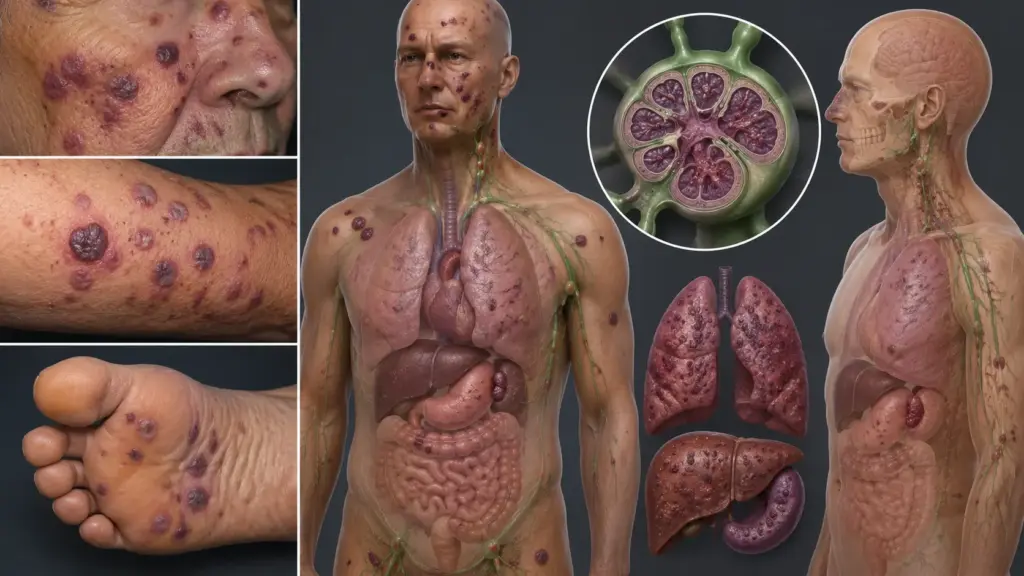
[IMAGE SUGGESTION: Kaposi’s sarcoma skin lesions and anatomical spread diagram — clinical diagram showing typical purple-red nodules and lymph node involvement — Alt text: “Kaposi’s sarcoma skin lesions and anatomical spread diagram — purple-red nodules and lymph nodes”]
What Is Kaposi Sarcoma?
Kaposi sarcoma is a malignancy characterized by the abnormal proliferation of endothelial cells resulting from HHV-8 (KSHV) infection. The virus causes cells to divide excessively, live longer, form new blood vessels, and become inflamed by introducing genes into the cells. Over time, these changes can lead to the cells becoming cancerous. However, most people with HHV-8 infection do not develop Kaposi sarcoma; immunosuppression (HIV infection, immunosuppressive medications after organ transplantation, advanced age) plays a critical role as a cofactor in the onset of the disease.
Kaposi’s sarcoma is classified into four epidemiological forms based on its clinical course: classic (in elderly men of Mediterranean descent), endemic (in Africa), iatrogenic (following immunosuppression after organ transplantation), and AIDS-associated (epidemic). The AIDS-associated form has the most aggressive course and may present with widespread disease at the time of diagnosis. Kaposi sarcoma is also associated with primary effusion lymphoma and multicentric Castleman disease.
Assoc. Prof. Dr. Şengül emphasizes that a significant proportion of patients diagnosed with Kaposi’s sarcoma in clinical practice overlook their skin lesions, mistaking them for “a simple allergy” or “dilated blood vessels”; and notes that newly developing skin changes, particularly in HIV-positive patients, must be evaluated immediately.
What Causes Kaposi’s Sarcoma?
The answer to the question “What causes Kaposi’s sarcoma?” lies in the interaction between HHV-8 (KSHV) infection and immunosuppression. HHV-8 is a DNA virus belonging to the Herpesviridae family. Primary infection typically occurs during childhood or adulthood. The virus can be transmitted through saliva (the primary horizontal route of transmission), sexual contact, blood transfusion, and organ transplantation. In endemic regions, transmission via saliva is common during childhood; in the U.S. and Western Europe, however, sexual transmission among adults (particularly among MSM) is more prevalent.
HIV infection is the strongest risk factor for the development of Kaposi’s sarcoma. Among HIV-positive men who have sex with men (MSM), the highest reported incidence is 1,397 cases per 100,000 person-years. The use of HAART reduces the incidence of Kaposi’s sarcoma by a factor of 6.57. Among organ transplant recipients, the incidence is 68.59 cases per 100,000 person-years. In the general population, the incidence is 1.53 cases per 100,000per 100,000 person-years.
According to Assoc. Prof. Dr. Nilay Şengül, the risk of Kaposi’s sarcoma in HIV-positive patients increases significantly when the CD4 cell count falls below 200/µL; therefore, regular antiretroviral therapy and monitoring of immune function are of vital importance in preventing the disease and ensuring early diagnosis.
Symptoms of Kaposi’s Sarcoma
The symptoms of Kaposi’s sarcoma vary depending on the form and stage of the disease. It most commonly begins with skin and mucosal involvement:
- Skin lesions: Purple, red, or brown flat patches, nodules, or plaques; they often appear on the legs, face, and genital area.
- Mucosal involvement: Lesions inside the mouth (palate, gums), pharynx, and larynx; may cause difficulty swallowing.
- Lymph node enlargement: Enlarged lymph nodes in the neck, armpits, or groin, often accompanied by swelling in the legs (lymphedema).
- Lung involvement: In cases of Kaposi’s sarcoma involving the lungs, cough, shortness of breath, chest pain, and bloody sputum; Kaposi’s sarcoma involving the lungs can lead to serious morbidity.
- Gastrointestinal involvement: Abdominal pain, diarrhea, weight loss, gastrointestinal bleeding.
- Systemic symptoms: Fever, night sweats, weight loss of more than 10%, diarrhea (>2 weeks) — referred to as “B symptoms.”
Stages of Kaposi’s Sarcoma
Kaposi’s sarcoma staging is performed using the TIS (Tumor-Immune System-Systemic Disease) system developed by the AIDS Clinical Trials Group (ACTG). Each parameter is classified as low risk (0) or high risk (1):
| Parameter | Good Risk (0) | Poor Risk (1) |
|---|---|---|
| T (Tumor) | Limited to the skin and/or lymph nodes; minimal oral disease | Tumor-related edema or ulceration; widespread oral KS; gastrointestinal KS; other visceral involvement |
| I (Immune system) | CD4 ≥200/µL | CD4 <200/µL |
| S (Systemic disease) | No history of opportunistic infections or thrush; no “B” symptoms; Karnofsky performance status ≥70 | History of opportunistic infections and/or thrush; “B” symptoms present; Karnofsky performance status <70 |
According to the ACTG study, median survival in low-risk (T0) patients is 27 months, and 15 months in high-risk (T1) patients. For immune status, median survival is 40 months for (I0) and 13 months for (I1). When the CD4 count is set at 150/µL instead of 200/µL, the prognostic distinction is more accurate. Tumor stage and CD4 count are the most predictive parameters for survival.
Kaposi Sarcoma Treatment
Treatment for Kaposi’s sarcoma is personalized based on the form and stage of the disease, as well as the patient’s immune status. Basic treatment principles:
| Treatment | Dose | Response Rate |
|---|---|---|
| Pegylated liposomal doxorubicin | 20 mg/m², every 2–3 weeks | %59 |
| Paclitaxel | 135–175 mg/m², every 3 weeks | 59–71% |
| ABV | Every 2–4 weeks | %24–88 |
| Vinblastine/vincristine | Weekly | 45% |
According to Assoc. Prof. Dr. Nilay Şengül, the fundamental role of HAART in the treatment of Kaposi’s sarcoma cannot be overlooked; however, in advanced-stage disease where HAART alone is insufficient, combination therapy with systemic chemotherapy agents such as liposomal anthracyclines and paclitaxel should be planned. Initiating systemic treatment early, particularly in patients with lung and gastrointestinal involvement, reduces morbidity.
Clinical Assessment by Assoc. Prof. Dr. Nilay Şengül
In my clinical practice, I frequently observe the following: A portion of HIV-positive patients diagnosed with Kaposi’s sarcoma tend to normalize their skin lesions as “a symptom of HIV” and delay seeking medical evaluation. In particular, patients with oral mucosal involvement may present with complaints of difficulty swallowing and weight loss, even though gastrointestinal involvement may actually be present.
According to Assoc. Prof. Dr. Nilay Şengül, every new skin lesion in HIV-positive patients should be evaluated via biopsy, and staging should be performed using whole-body CT/PET-CT; in early-stage Kaposi’s sarcoma, the combination of HAART and local treatment achieves high success in controlling the disease. This approach underscores the vital importance of regular skin and mucosal examinations, particularly in patients with CD4 counts below 200/µL.
From Diagnosis to Recovery: How Does the Process Proceed?
The diagnosis and treatment process for Kaposi’s sarcoma progresses in stages depending on the patient’s clinical condition:
- Initial Examination and Evaluation: A detailed medical history is taken from patients presenting with suspected Kaposi’s sarcoma. The onset of skin lesions, their growth rate, and the presence of pain and itching are assessed. HIV status, CD4 count, viral load, and history of antiretroviral therapy are evaluated. A history of organ transplantation, use of immunosuppressive medications, and family history of Kaposi’s sarcoma are also inquired about. During the physical examination, the skin, mucous membranes, lymph nodes, and abdomen are examined in detail.
- Tests and Imaging: A definitive diagnosis is is established by incisional or puncture biopsy. Histopathology reveals spindle cell proliferation, slide-like vascular structures outside red blood cells, and positivity for HHV-8 immunohistochemistry (LANA-1). HIV testing, CD4 count, and viral load are measured. Chest CT evaluates lung involvement; abdominal CT demonstrates gastrointestinal and liver involvement. Endoscopy and bronchoscopy are used to evaluate mucosal and lung lesions. PET-CT is helpful in staging and monitoring treatment response.
- Treatment Planning: Findings are evaluated by a multidisciplinary oncology board (medical oncology, infectious diseases, radiation oncology, pathology). Optimization of HAART is a priority in HIV-positive patients. For limited cutaneous disease, local treatments (cryotherapy, radiation therapy, intralesional chemotherapy) are planned; for widespread or visceral disease, systemic chemotherapy (liposomal anthracyclines, paclitaxel) is planned. In organ transplant patients, reducing immunosuppression or switching to sirolimus (rapamycin) is considered.
- Treatment Process and Hospital Stay: Local treatments (cryotherapy, radiation therapy) are generally administered on an outpatient basis. Systemic chemotherapy is administered intravenously every 2–3 weeks; the infusion duration is 1–2 hours. The hospital stay is either same-day or 1–2 days, depending on the chemotherapy protocol. Side effect management (neutropenia, anemia, mucositis) is closely monitored. HAART continues concurrently with chemotherapy.
- Recovery After Discharge: Wound healing following local treatment is complete within 2–4 weeks. Hyperpigmentation or hypopigmentation may remain on the skin after radiation therapy. Recovery of immune function after chemotherapy takes 2–4 weeks. A return to light activities is possible within 1–2 weeks. As part of the follow-up plan, clinical examinations, CD4 counts, HIV viral load testing, and skin/mucosal examinations are recommended every 1–3 months during the first year and every 3–6 months in subsequent years. Recurrence is common; complete remission is difficult.
According to Assoc. Prof. Dr. Nilay Şengül, during the follow-up period after Kaposi’s sarcoma treatment, close monitoring is critical in the first few months after starting HAART, particularly in HIV-positive patients, due to the risk of immune reconstitution inflammatory syndrome (IRIS); the development of new lesions or worsening of existing lesions should raise suspicion of IRIS or treatment failure.
Frequently Asked Questions
How is Kaposi’s Sarcoma treated?
Kaposi sarcoma is treated with HAART (in HIV-positive patients), local therapies (cryotherapy, radiation therapy, surgical excision, intralesional chemotherapy), and systemic chemotherapy (liposomal anthracyclines, paclitaxel, ABV regimen). The choice of treatment is determined based on the stage of the disease, immune status, and site of involvement. In iatrogenic Kaposi sarcoma, reducing immunosuppression or switching to sirolimus is the first step.
Is there a treatment for Kaposi’s sarcoma?
Yes, there is a treatment for Kaposi’s sarcoma. However, the disease cannot be completely cured at this time. Treatment helps reduce or eliminate lesions and alleviate symptoms such as edema and ulceration. HAART is the primary treatment for HIV-associated Kaposi’s sarcoma and significantly reduces its incidence. Local and systemic treatments are used for symptom control and to address cosmetic concerns. Clinical trials may be considered for new treatment approaches.
Does Kaposi’s Sarcoma Recur?
Yes, Kaposi’s sarcoma tends to recur. Lesions often recur after local treatments (cryotherapy, radiation therapy, surgery). For this reason, a complete cure is difficult to achieve. The use of HAART reduces the risk of recurrence. Recurrence typically occurs when immunosuppression persists or develops anew. Regular follow-up and maintenance of immune function minimize the risk of recurrence.
Is Kaposi’s Sarcoma Contagious?
Kaposi’s sarcoma itself is not contagious. However, the answer to the question how is Kaposi’s sarcoma transmitted lies in the transmission routes of the HHV-8 (KSHV) virus. HHV-8 can be transmitted through saliva (the primary route of transmission), sexual contact, blood transfusions, and organ transplants. In endemic regions, transmission via saliva is common during childhood. In the U.S. and Western Europe, sexual transmission among adults (particularly among MSM) is more common. The virus is not transmitted through everyday social contact.
Kaposi’s Sarcoma: Is Kaposi’s Sarcoma Fatal?
The prognosis for Kaposi’s sarcoma varies depending on its form and stage. In low-risk (T0, I0, S0) patients, the median survival is 27–40 months, whereas in high-risk (T1, I1, S1) patients, this period drops to 13–15 months. The use of HAART has significantly improved survival in HIV-associated Kaposi sarcoma. However, advanced stage, visceral involvement, and concomitant opportunistic infections increase the risk of mortality. The classical and endemic forms generally have a more indolent course. Life expectancy in Kaposi’s sarcoma varies depending on treatment response and immune status.
Kaposi’s sarcoma is a low-grade vascular malignancy associated with the HHV-8 (KSHV) virus and triggered by immunosuppression. The form associated with HIV/AIDS has the most aggressive course. Early diagnosis, HAART therapy, and a multidisciplinary approach significantly improve the prognosis. The ACTG TIS staging system is used to determine treatment strategy and predict survival. Local therapies are used for limited disease, while systemic chemotherapy is used for widespread or visceral involvement. Recurrence is common, and regular follow-up and maintenance of immune function are of vital importance.
To discuss your personal situation regarding Kaposi’s sarcoma and have your questions answered, you can consult with Assoc. Prof. Dr. Nilay Şengül. To schedule an appointment at the Memorial Şişli Hospital, please call 444 7 888.
Sources
- PMC/NIH, “Diagnosis and Treatment of Kaposi’s Sarcoma” — https://pmc.ncbi.nlm.nih.gov/articles/PMC9020379/
- PMC/NIH, “Epidemiology and Transmission of Kaposi’s Sarcoma-Associated Herpesvirus” — https://pmc.ncbi.nlm.nih.gov/articles/PMC4246215/
- PubMed/NIH, “The worldwide incidence of Kaposi’s sarcoma in the HIV/AIDS era” — https://pubmed.ncbi.nlm.nih.gov/29368388/
- UpToDate, “AIDS-related Kaposi sarcoma: Staging and treatment” — https://www.uptodate.com/contents/aids-related-kaposi-sarcoma-staging-and-treatment/print
- PubMed/NIH, “AIDS-related Kaposi’s sarcoma: prospective validation of the AIDS Clinical Trials Group staging classification” — https://pubmed.ncbi.nlm.nih.gov/9294471/
- MSD Manuals, “Kaposi Sarcoma – Oncology” — https://www.msdmanuals.com/professional/oncology/cancers-of-the-skin/kaposi-sarcoma
- American Cancer Society, “Kaposi Sarcoma Causes, Risk Factors, and Prevention” — https://www.cancer.org/cancer/types/kaposi-sarcoma/causes-risks-prevention.html
- NCBI Bookshelf/PDQ, “Kaposi Sarcoma Treatment (PDQ®): Health Professional Version” — https://www.ncbi.nlm.nih.gov/books/NBK65897/