At a Glance
- Oral cancer is a malignant tumour that can develop anywhere in the oral cavity; approximately 377,000 new cases and 177,000 deaths are reported worldwide each year.
- The 5-year survival rate in early-stage (Stage 1) disease is 8085%, while in advanced-stage (Stage 4) disease it falls to 2030%.
- Combined tobacco and alcohol use increases the risk of oral cancer up to 30-fold; HPV-related oropharyngeal cancers are increasing by 2% annually.
- Hospital stay after oral cancer surgery is 37 days; full recovery can range from a few weeks to several months.
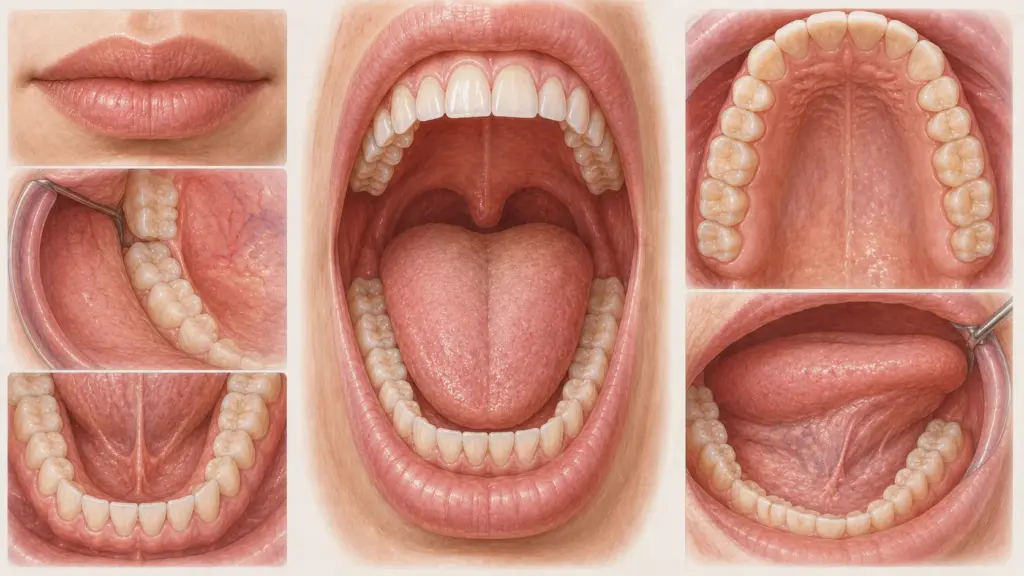
Oral cancer is a malignant tumour that can develop anywhere in the oral cavity, including the lips, tongue, gums, inner cheeks (buccal mucosa), palate, and floor of the mouth. Squamous cell carcinoma accounts for more than 90% of intraoral cancer cases. Early diagnosis directly affects both treatment success and functional outcomes; therefore oral cancer screening and risk factor awareness are of critical importance.
What Is Oral Cancer?
Oral cancer is a malignant neoplasm originating from the epithelial tissue of the oral cavity. This group, also referred to as intraoral cancer, covers the region extending from the lips to the beginning of the oropharynx. Squamous cell carcinoma is the most common histological subtype. The tumour can invade surrounding tissues locally, spread to regional lymph nodes, and develop distant metastasis. According to American Cancer Society data, 59,660 new cases and 12,770 deaths from oral cavity and pharyngeal cancer are expected in the USA in 2025.
The onset of oral cancer is generally asymptomatic and presents as a small ulcer or red/white spot. These early lesions (erythroplakia, leukoplakia) carry the potential for malignant transformation. Regular dental check-ups and oral cancer screening enable these lesions to be detected at an early stage.
Symptoms of Oral Cancer
The symptoms of oral cancer vary according to the location, size, and stage of the tumour. In early-stage disease, symptoms may be mild or indistinct; therefore awareness of intraoral cancer symptoms is of vital importance.
- An oral sore or ulcer that does not heal (lasting more than 2 weeks)
- Red (erythroplakia) or white (leukoplakia) plaques
- A hard mass or thickening inside the mouth
- Ear pain (especially related to swallowing)
- A palpable lymph node in the neck
- Bleeding, bad breath, and loose teeth
- Difficulty swallowing, chewing, or moving the tongue (in advanced cases)
Assoc. Prof. Dr Şengül emphasises in clinical practice that a significant proportion of patients diagnosed with oral cancer have delayed because they thought the changes inside the mouth were “gum inflammation” or “an aphthous ulcer”. She states that every oral lesion that does not heal should be evaluated within 2 weeks.
What Causes Oral Cancer?
The causes of oral cancer are multifactorial and involve the interaction of genetic predisposition and environmental risk factors:
- Tobacco use: Cigarettes, pipe, or chewing tobacco increases the risk of oral cancer 510 times.
- Alcohol consumption: Heavy alcohol use increases the risk 56 times; combined use of tobacco and alcohol raises the risk up to 30-fold.
- HPV infection: HPV-16 in particular is strongly associated with oropharyngeal cancers; these cancers are increasing at 2% annually.
- Sunlight exposure: Associated with lower lip cancers.
- Diet: A diet lacking in vegetables and fruit may increase risk.
- Immune deficiency: Post-transplant immunosuppression and HIV/AIDS-related increased risk.
According to Assoc. Prof. Dr Nilay Şengül, the increasing trend in HPV-related oral and oropharyngeal cancers highlights the importance of vaccination programmes; the FDA added the oral cancer prevention indication to the HPV vaccine in 2020, but the current vaccination rate for those aged 1317 remains at 61% in the USA.
Stages of Oral Cancer
Oral cancer stages are determined by the TNM (Tumour-Node-Metastasis) system. Oral cancer has 4 stages and their subcategories:
| Stage | Tumour Size/Spread | Lymph Node Involvement | 5-Year Survival |
| Stage 1 | Tumour 2 cm, 5 mm depth | None | 8085% |
| Stage 2 | Tumour 24 cm or >5 mm depth | None | 6070% |
| Stage 3 | Tumour >4 cm or lymph node involvement | Ipsilateral, single, 3 cm | 4050% |
| Stage 4 | Extensive invasion or distant metastasis | Multiple or contralateral | 2030% |
Oral Cancer Mortality Rate
The oral cancer mortality rate varies according to geographical region, stage, and risk factors. Approximately 177,000 deaths are reported globally each year. In the USA, the mortality rate for oral cavity and pharyngeal cancers is 2.7 per 100,000 (age-adjusted). The mortality rate in men (4.1) is almost 3 times higher than in women (1.4).
Treatment of Oral Cancer
Oral cancer treatment is planned multidisciplinarily according to stage, tumour location, histological type, and the patient’s general condition:
- Surgical Resection: The basic treatment in early-stage disease. The tumour is removed together with a margin of healthy tissue (safety margin). Neck dissection accompanies when lymph node involvement is suspected.
- Radiotherapy: Applied alone or as adjuvant treatment after surgery. The main treatment option in advanced-stage disease or when surgery is contraindicated.
- Chemotherapy: Generally used in combination with radiotherapy (concurrent chemoradiotherapy). Considered in systemic spread or as neoadjuvant treatment.
- Immunotherapy: PD-1 inhibitors such as pembrolizumab and nivolumab are among the systemic treatment options in recurrent or metastatic disease.
- Targeted Therapies: Cetuximab (EGFR inhibitor) can be used in combination with platinum-based chemotherapy.
- Reconstruction: Free flap or local flap reconstruction is applied to restore function and aesthetics after surgery.
According to Assoc. Prof. Dr Nilay Şengül, when planning oral cancer treatment, preserving speech, swallowing, and chewing functions is a priority alongside local tumour control; therefore the treatment decision must be taken in a multidisciplinary oncology board.
Oral Cancer Surgery
Oral cancer surgery is performed with different techniques according to the location and size of the tumour:
- Local excision: For small, superficial tumours; minimal functional loss.
- Glossectomy: For tongue tumours; partial, subtotal, or total glossectomy.
- Mandibulectomy: For tumours invading the jawbone; partial or segmental resection.
- Neck dissection: When lymph node metastasis is suspected or in high-risk situations.
- Free flap reconstruction: Reconstruction with fibula, radial forearm, or anterolateral thigh flap.
After Oral Cancer Surgery
The post-operative period after oral cancer surgery involves recovery and rehabilitation phases. Hospital stay is 37 days depending on the scope of surgery. Post-operative pain control, nutritional support, and wound care are of critical importance.
Swelling peaks in the first week and speech may be temporarily impaired. Feeding begins with a soft diet and normal diet is achieved in subsequent weeks. Speech and swallowing therapy must be initiated within 3 months in patients who have undergone reconstruction. Shoulder dysfunction may be seen in up to 70% of patients who have had neck dissection; early rehabilitation is recommended.
Clinical Assessment by Assoc. Prof. Dr Nilay Şengül
I frequently observe the following in clinical practice: The majority of patients diagnosed with oral cancer have been ignoring their symptoms for weeks or months. Small ulcers on the edge of the tongue or buccal mucosa in particular are dismissed as “tooth friction” or “vitamin deficiency”.
According to Assoc. Prof. Dr Nilay Şengül, every intraoral lesion lasting more than 2 weeks requires evaluation by biopsy; early-stage diagnosis directly increases both survival and the chance of organ-preserving surgery. This approach demonstrates the vital importance of regular oral cancer screening protocols particularly in high-risk patients (those with a history of tobacco and alcohol use).
From Diagnosis to Recovery: How Does the Process Proceed?
- Initial Examination and Assessment: A detailed history is taken from the patient presenting with suspected oral cancer. Tobacco and alcohol use, HPV history, family history of cancer, and the duration of current symptoms are questioned. In oral cavity examination, the location, size, borders of the lesion, and lymph node palpation are evaluated.
- Investigations and Imaging: Incisional biopsy confirms the diagnosis. Panoramic radiography or dental CT evaluates bone involvement. Neck CT/MRI shows lymph node involvement and tumour depth. PET-CT is used for distant metastasis screening. Full blood count, liver and kidney function tests, and coagulation parameters are evaluated.
- Treatment Planning: The findings obtained are evaluated in the multidisciplinary oncology board (surgical oncologist, medical oncologist, radiation oncologist, radiologist, pathologist). In early-stage disease (Stage 12), surgical resection; in advanced-stage disease (Stage 34), surgery + adjuvant radiotherapy/chemoradiotherapy is planned. The need for reconstruction is an integral part of surgical planning.
- Surgical Process and Hospital Stay: Oral cancer surgery is performed under general anaesthesia. Hospital stay is 37 days depending on the scope of surgery. Post-operative pain control, nutritional support (oral, nasogastric, or PEG), and wound care are closely monitored. The decision for adjuvant treatment is made based on pathology results.
- Post-Discharge Recovery: Full recovery can range from a few weeks to several months. Return to light desk work is possible within 23 weeks. Speech and swallowing therapy must be initiated within 3 months. Controls are recommended every 13 months in the first year, then every 36 months in subsequent years. Dental check-ups should be performed regularly every 36 months.
Frequently Asked Questions
What Are the First Signs of Oral Cancer?
The first signs of oral cancer are generally vague and can be confused with other oral diseases. The most common early signs are: an ulcer lasting more than 2 weeks that does not heal, red or white plaques, a hard mass inside the mouth, ear pain, and swelling in the neck. If one or more of these signs are present, a healthcare facility should be consulted immediately.
Is Oral Cancer Treatable?
Yes, oral cancer treatment is possible and treatment options are determined according to stage. In early-stage disease (Stage 12), surgical resection alone may be sufficient; the 5-year survival rate reaches 8085%. In advanced-stage disease, a combination of surgery, radiotherapy, chemotherapy, immunotherapy, and targeted therapies is applied. Early diagnosis directly affects treatment success and quality of life.
Is Oral Cancer Contagious?
Oral cancer is not directly contagious. However, HPV infection (particularly HPV-16) can be sexually transmitted and increases the risk of oropharyngeal cancer. The HPV vaccine reduces the risk of both cervical and oral cancer. Tobacco and alcohol use are not contagious but significantly increase the risk of oral cancer.
Oral cancer is a malignancy with high treatment success in early-stage disease but with severely worsening prognosis when diagnosed late. Squamous cell carcinoma is the most common histological type, and tobacco, alcohol, and HPV are the principal risk factors.
You can consult Assoc. Prof. Dr Nilay Şengül to evaluate your personal situation regarding oral cancer and to have your questions answered. To book an appointment at Memorial Şişli Hospital, you can call 444 7 888.
References
- PMC/NIH, “Guidelines for the Surgical Management of Oral Cancer” https://pmc.ncbi.nlm.nih.gov/articles/PMC6453784/
- American Cancer Society, Cancer Facts & Figures 2025
- SEER/NCI, Cancer Stat Facts: Oral Cavity and Pharynx Cancer https://seer.cancer.gov/statfacts/html/oralcav.html
- RCSEng, Oral cancer: a global threat, 2025 https://publishing.rcseng.ac.uk/doi/10.1308/rcsbull.2025.91