📌 What You Need to Know in a Nutshell
- Prostate cancer is the most common cancer in men; an estimated 333,830 new cases were reported in the U.S. in 2026.
- In localized stages, the 5-year relative survival rate reaches 98%; in the metastatic stage, this rate is approximately 38%.
- Active surveillance is the primary approach in early stages, while hormonal therapy combined with newer-generation antiandrogens is the primary approach in advanced stages.
- The hospital stay following radical prostatectomy is 1–2 days; full recovery occurs within 4–6 weeks.
Prostate cancer is the most common malignancy in men, accounting for approximately 30% of all male cancers with an estimated 333,830 new cases in the United States as of 2026. A distinctive feature of the disease is that most cases can be detected at an early stage and are asymptomatic; this allows the 5-year relative survival rate to reach %98. However, in cases that progress to the metastatic stage, the 5-year survival rate drops to approximately 38%, making personalized treatment strategies based on early diagnosis and staging critically important.
What Is Prostate Cancer?
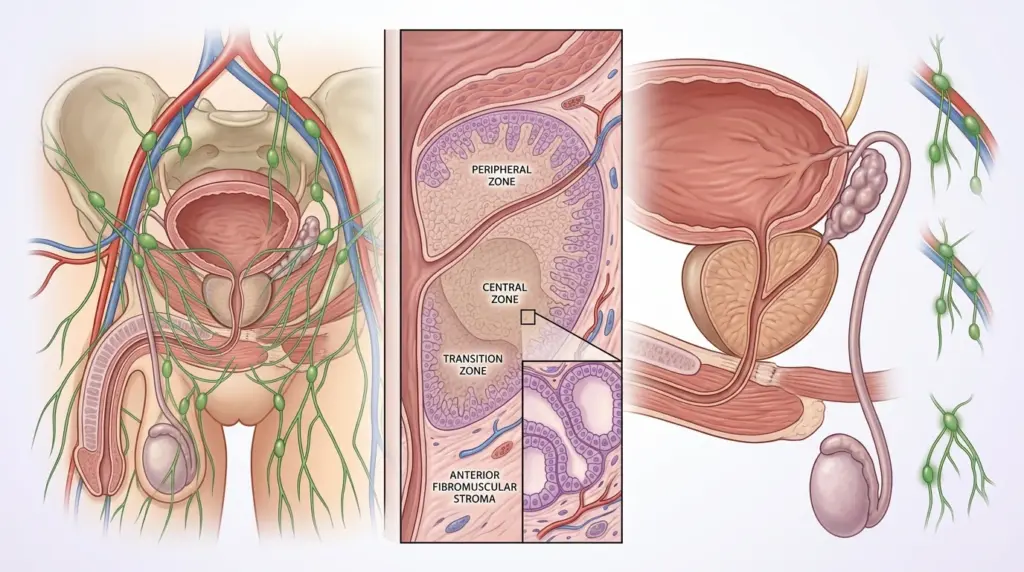
Prostate cancer is a malignant neoplasm originating from the glandular tissue of the prostate gland, most commonly presenting as adenocarcinoma (95%). The disease can originate from three anatomical regions: the peripheral zone (70%), the transition zone (20%), and the central zone (10%). This cancer, which is generally asymptomatic in its early stages, leads to difficulty urinating, bone pain, and systemic symptoms as it progresses.
According to World Health Organization data, prostate cancer was recorded as the third most common cancer worldwide in 2020, with 1,414,259 new cases. Age, family history, and race/ethnicity are the strongest risk factors; incidence increases significantly in men over 50, and 55% of deaths among men over 65 are attributable to this disease.
According to Assoc. Prof. Dr. Nilay Şengül, in the vast majority of patients diagnosed with prostate cancer, the disease is localized or regionally advanced; this situation represents a significant advantage in terms of expanded treatment options and high survival rates. However, in recent years, an increase in the rate of advanced-stage diagnoses has been observed alongside changes in PSA screening recommendations.
What Are the Symptoms of Prostate Cancer?
Symptoms of early-stage prostate cancer are generally nonspecific and can be confused with benign prostatic hyperplasia (BPH). As the disease progresses, the symptoms become more distinct. The table below summarizes the symptoms of prostate cancer by stage:
| Stage | Typical Symptoms | Frequency |
|---|---|---|
| Stage 1 | Generally asymptomatic; detected incidentally via PSA screening or biopsy | 83% (localized/regional) |
| Stage 2-3. Stage | Frequent urination, difficulty starting urination, weak stream, nocturia, blood in the urine (hematuria) | Variable |
| 4. Stage | Bone pain (especially in the spine and hips), weight loss, fatigue, leg swelling, anemia | In all metastatic cases |
In cases of advanced prostate cancer, patients typically present with metastatic symptoms. Bone metastases most commonly affect the spine, pelvis, and long bones; in such cases, persistent bone pain, risk of pathological fractures, and spinal cord compression may develop.
Assoc. Prof. Dr. Şengül notes that in her clinical practice, a significant proportion of patients diagnosed with prostate cancer present to urology due to urinary symptoms, but emphasizes that these symptoms may overlap with those of BPH. For this reason, she stresses that regular PSA screening and digital rectal exams should not be neglected in men over the age of 50.
What Causes Prostate Cancer?
Multiple factors play a role in the development of prostate cancer. These factors include the interaction of genetic predisposition, hormonal environment, and environmental factors. The following list summarizes the key risk factors supported by scientific literature:
- Age: This is the strongest risk factor. While the incidence is 1 in 350 among those under 50, it rises to 1 in 56 in the 50–59 age group, 1 in 19 in the 60–69 age group, and 1 in 15 in the 70–79 age group. The lifetime risk is approximately 12.8% (1 in 8 men).
- Family History: The risk increases approximately fourfold in men with a first-degree relative (father or brother) who has had prostate cancer.
- Race/Ethnicity: Incidence is highest among Black men (191.5 per 100,000); mortality rates are nearly twice as high as those for White men.
- Genetic Mutations: Mutations in genes such as BRCA1, BRCA2, and HOXB13 increase the risk of aggressive disease.
- Diet and Lifestyle: High consumption of saturated fat, obesity, and smoking can increase the risk.
The answer to the question “Is prostate cancer genetic?” must be evaluated in the context of family history and specific gene mutations. While the risk of prostate cancer is 2–6 times higher in BRCA2 carriers, this mutation is also associated with more aggressive disease and.
Stages of Prostate Cancer
The prostate cancer staging system is based on a combination of the TNM (Tumor-Node-Metastasis) classification and the Gleason score. Staging plays a fundamental role in determining the treatment strategy and predicting the prognosis.
| Stage | Definition | 5-Year Survival |
|---|---|---|
| Stage 1 | Cancer is confined to the prostate, microscopic; cannot be detected by PSA or DRE | >99% |
| Stage 2 | Cancer is confined to the prostate but can be detected by DRE and/or PSA | >99% |
| Stage 3 Stage | Cancer has spread outside the prostate; may involve the seminal vesicles or adjacent organs | >99% (regional) |
| Stage 4A | Metastasis to nearby lymph nodes | ~50–60% |
| Stage 4B | Distant organ metastasis (bone, lung, liver) | ~30–38% |
Stage 1 prostate cancer typically has no symptoms, and the disease is often detected incidentally. In stage 4 prostate cancer, however, systemic symptoms become prominent. While the chances of survival for stage 4 prostate cancer have increased with modern treatments, it is important to note that the disease cannot be cured; the goal is to control the disease and maintain quality of life.
The key parameters used to determine the stages of prostate cancer are as follows:
- PSA Level: Below 10 ng/mL is low risk, 10–20 ng/mL is intermediate risk, and >20 ng/mL is high risk
- Gleason Score / Grade Group: Classified on a scale from 1 (well-differentiated) to 5 (poorly differentiated)
- Clinical T Stage: Tumor size and spread determined by digital rectal exam and imaging
Prostate Cancer Treatment
Prostate cancer treatment is personalized based on the disease stage, Gleason score, PSA level, the patient’s age, and any comorbidities. The treatment approach encompasses a broad spectrum, ranging from active surveillance to radical surgery, radiation therapy, and systemic therapies.
Prostate Cancer Treatment Methods
1. Active Surveillance: This approach is preferred for very low-risk and low-risk patients. Disease progression is monitored through regular PSA testing, digital rectal exams, and magnetic resonance imaging (MRI). While the usage rate of this approach was 26.5% in 2014, it rose to 59.6% in 2021; this increase reflects efforts to reduce the risk of overtreatment.
2. Surgical Treatment (Radical Prostatectomy): It is performed with curative intent in localized and regional-stage disease. Open, laparoscopic, and robot-assisted approaches are available. Robotic surgery offers the advantages of less bleeding, a shorter hospital stay, and faster recovery.
3. Radiation Therapy: It can be administered as external beam radiation therapy (EBRT) or brachytherapy (implantation of radioactive seeds). In high-risk patients, it is combined with hormonal therapy.
4. Hormonal Therapy (ADT): Androgen deprivation therapy is the primary treatment for metastatic disease. It slows tumor growth by suppressing testosterone production. GnRH agonists/antagonists, bilateral orchiectomy, or newer-generation antiandrogens (abiraterone, enzalutamide, apalutamide) are used.
5. Chemotherapy: When docetaxel is added to ADT in hormone-sensitive metastatic disease, it provides a 9% absolute improvement in 4-year survival. It is also used in castration-resistant disease.
6. Targeted Therapies: PARP inhibitors (olaparib, rucaparib) have demonstrated efficacy in patients with BRCA mutations, while PSMA-targeted radioligand therapies (Lutetium-177) have shown efficacy in metastatic castration-resistant disease.
According to Assoc. Prof. Dr. Nilay Şengül, the most critical decision in prostate cancer treatment is to accurately assess the aggressiveness of the disease and determine an appropriate strategy. Overtreatment in a low-risk patient or undertreatment in an advanced-stage patient can negatively affect both survival and quality of life.
| Risk Group | Recommended Initial Treatment | Expected Outcome |
|---|---|---|
| Very Low Risk | Active surveillance | Avoidance of treatment side effects, high survival |
| Low Risk | Active surveillance (preferably), RT, or RP | >99% 5-year survival |
| Intermediate Risk | RT + ADT or RP | High local control, good long-term survival |
| High / Very High Risk | RT + ADT + ARSI or RP | Systemic control, metastasis prevention |
| Metastatic (Stage 4) | ADT + abiraterone/enzalutamide/apalutamide ± docetaxel | Disease control, symptom palliation |
Prostate Cancer Surgery
Radical prostatectomy is the primary surgical procedure performed for curative intent in localized prostate cancer. During the procedure, the prostate gland, seminal vesicles, and proximal ends of the vas deferens are removed. In intermediate- and high-risk patients, pelvic lymph node dissection is also performed.
Surgical approaches fall into three main groups:
- Open Radical Prostatectomy: Performed via a retropubic or perineal approach; the average hospital stay is 2 days, and full recovery takes approximately 2 months.
- Laparoscopic Radical Prostatectomy: Performed through several small incisions; hospital stay is 1–2 days, and recovery takes 3to 5 weeks.
- Robot-Assisted Laparoscopic Prostatectomy: This is the most commonly preferred method; it results in less bleeding, more precise dissection, and faster recovery.
The answer to the question “How long does prostate cancer surgery take?” varies depending on the technique used and the patient’s anatomy. With the robotic approach, the procedure typically takes between 2 and 4 hours. With open surgery, this time may be slightly longer.
After Prostate Cancer Surgery
The postoperative process following prostate cancer surgery varies depending on the patient’s overall condition and the surgical technique used. The standard timeline is as follows:
- Early Phase (0–2 weeks): The hospital stay is 1–2 days. The urinary catheter remains in place for 7–14 days. Oral analgesics are sufficient for pain control. The patient begins walking on the day of surgery or the following day.
- Middle Phase (2–6 weeks): Bladder control improves over time after the catheter is removed. Lifting objects weighing more than 4.5 kg is prohibited for the first 4 weeks. Driving is permitted after the catheter is removed and with the doctor’s approval.
- Late Phase (6–12 weeks): A return to normal daily activities is achieved within 4–6 weeks. Returning to work is possible within 3–5 weeks. The return of sexual function may take 6 months or longer; oral medications or other treatments may help.
Life expectancy after prostate cancer surgery depends on the stage of the disease and its pathological characteristics. In localized disease, the 15-year survival rate is over 95%. However, adjuvant therapy may be necessary for patients with positive surgical margins or lymph node involvement identified in the pathology report.
Assoc. Prof. Dr. Şengül, notes that in clinical practice, the most common questions asked by patients after radical prostatectomy are about urinary incontinence and sexual dysfunction. She emphasizes that these symptoms improve over time in most patients, but that the rate of recovery varies from patient to patient.
From Diagnosis to Recovery: How Does the Process Unfold?
- Initial Examination and Evaluation: A detailed medical history is taken from the patient regarding urinary symptoms, pain, weight loss, and family history. A digital rectal exam (DRE) is used to assess prostate size, firmness, and nodularity.
- Tests and Imaging: A PSA blood test, a biopsy guided by transrectal ultrasound (TRUS), pelvic MRI, and, if necessary, a bone scan or PET-CT are ordered. The answer to the question “Can prostate cancer be detected on an ultrasound?”is that TRUS can provide information about the tumor’s location and size; however, a definitive diagnosis is made via biopsy.
- Pathological Evaluation and Staging: The Gleason score and grade group are determined from the biopsy specimens. A Gleason score of 6 (grade group 1) indicates low risk, 8–10 (grade group 4–5) indicates high risk.
- Treatment Planning: At a multidisciplinary oncology board meeting (tumor board), specialists in surgery, radiation oncology, and medical oncology meet to determine the most appropriate treatment strategy.
- Treatment Implementation: If surgery is selected, robotic or open radical prostatectomy is performed. If radiation therapy is selected, fractionated treatment lasting 6–8 weeks is administered. If systemic therapy is required, hormonal therapy is initiated.
- Hospital Stay and Discharge: The hospital stay following radical prostatectomy is 1–2 days. Discharge criteria include tolerance of oral intake, pain control, mobility, and the absence of complications.
- Follow-up and Recovery: The first follow-up visit takes place 1–2 weeks later (for suture removal or catheter removal). PSA monitoring is performed every 3 months in the first year and every 6 months in subsequent years. Return to work is generally possible within 3–5 weeks.
Frequently Asked Questions
Is It Prostate Cancer?
It is a malignant tumor resulting from the uncontrolled proliferation of prostate gland cells. Adenocarcinoma (95%) is the most common histological type. It must be distinguished from benign prostate conditions (BPH, prostatitis).
How Does Prostate Cancer Develop?
It develops as a result of a combination of age, genetic predisposition, hormonal factors, and environmental influences. Testosterone and other androgens promote tumor growth. The risk increases 2- to 6-fold in individuals with a BRCA2 mutation.
What Causes Prostate Cancer?
It develops as a result of the malignant transformation of prostate epithelial cells due to the accumulation of mutations. DNA damage accumulates with age; the risk increases significantly in men over 50. The risk is approximately four times higher in those with a family history.
How Is Prostate Cancer Diagnosed?
It is generally not detectable in the early stages. Early diagnosis is possible through PSA screening and a digital rectal exam. In advanced stages, it presents with urinary symptoms, bone pain, weight loss, and fatigue. A definitive diagnosis is made through a biopsy guided by transrectal ultrasound.
What Helps with Prostate Cancer?
Treatment selection depends on the stage of the disease. In early stages, surgery or radiation therapy may be curative. In advanced stages, hormone therapy, chemotherapy, and targeted therapies help control the disease. Lifestyle changes (balanced diet, regular exercise) support treatment.
Is Prostate Cancer Genetic?
It is partially genetic. The risk increases approximately fourfold in individuals with a family history of prostate cancer in a first-degree relative. BRCA1, BRCA2, and HOXB13 gene mutations increase the risk of aggressive disease. Genetic counseling is recommended for those with a family history.
Can Prostate Cancer Be Detected on an Ultrasound?
Transrectal ultrasound (TRUS) can detect hypoechoic lesions in the prostate gland, but this finding is not diagnostic. A systematic biopsy guided by TRUS is required for a definitive diagnosis. Most early-stage cancers may not be visible on ultrasound.
What Happens If Prostate Cancer Spreads to the Bones?
Bone metastases most commonly affect the spine, pelvis, and long bones. Bone pain, risk of pathological fractures, hypercalcemia, and spinal cord compression may develop. Treatment options include hormone therapy, chemotherapy, bisphosphonates, and radiopharmaceuticals (Radium-223).
Is Prostate Cancer Dangerous?
It is a cancer with a very good prognosis in the early stages; the 5-year survival rate for localized disease is over 98%. However, in the metastatic stage, the 5-year survival rate drops to approximately 38%. With early diagnosis and appropriate treatment, most patients can live for many years.
Is There a Treatment for Prostate Cancer?
Yes, curative treatment is possible in localized and regional stages. The disease can be brought under control with radical prostatectomy or radiation therapy. Although curative treatment is not possible in the metastatic stage, the disease can be kept under control for a long time with hormonal therapy, chemotherapy, immunotherapy, and targeted therapies.
Does Prostate Cancer Cause Death?
The risk of death from prostate cancer varies depending on the stage. In localized disease, the 15-year survival rate is over %95 percent. However, the mortality rate from prostate cancer increases in the metastatic stage; an estimated 35,770 deaths from prostate cancer are expected in the U.S. in 2026. Early diagnosis significantly reduces this risk.
How Long Does Prostate Cancer Surgery Take?
Robotic radical prostatectomy takes an average of 2–4 hours. The procedure may take slightly longer with open surgery. The hospital stay is 1–2 days for the robotic approach and 2 days for the open approach. Full recovery occurs within 4–6 weeks.
In this article, we have provided comprehensive information about prostate cancer, including its definition, symptoms, stages, treatment methods, and the surgical process. A 5-year survival rate of up to %98, demonstrating that this disease can be successfully managed with early diagnosis. Awareness of risk factors, regular screening, and personalized treatment strategies based on staging optimize both survival and quality of life.
To assess your personal situation regarding prostate cancer and have your questions answered, you can consult with Assoc. Prof. Dr. Nilay Şengül. To schedule an appointment at the Memorial Şişli Hospital clinic, please call 444 7 888.
Sources
- Siegel RL et al., CA: A Cancer Journal for Clinicians, 2026 — “Cancer statistics, 2026” — https://pmc.ncbi.nlm.nih.gov/articles/PMC12798275/
- Siegel RL et al., CA: A Cancer Journal for Clinicians, 2025 — “Prostate cancer statistics, 2025” — https://pmc.ncbi.nlm.nih.gov/articles/PMC12593258/
- National Cancer Institute, Prostate Cancer Treatment PDQ, 2025 — “Treatment of Stage IV Prostate Cancer” — https://www.cancer.gov/types/prostate/hp/prostate-treatment-pdq
- Mayo Clinic, 2026 — “Prostate cancer stages” — https://www.mayoclinic.org/diseases-conditions/prostate-cancer/stages/gnc-20595689
- Mayo Clinic, 2026 — “Prostatectomy (prostate removal surgery)” — https://www.mayoclinic.org/tests-procedures/prostatectomy/about/pac-20385198
- Mayo Clinic, 2025 — “Survival rates for metastatic castration-resistant prostate cancer” — https://www.mayoclinic.org/diseases-conditions/metastatic-castration-resistant-prostate-cancer/survival-rates/gnc-20593193
- Johns Hopkins Medicine, 2026 — “Prostate Cancer Prognosis” — https://www.hopkinsmedicine.org/health/conditions-and-diseases/prostate-cancer/prostate-cancer-prognosis
- WHO/NCSS, “Guideline on Testing for Prostate Cancer” — https://extranet.who.int/ncdccs/Data/ZAF_D1_PrCa%20Guideline.pdf
- PMC/NIH, 2023 — “The Risk Factors and Screening Uptake for Prostate Cancer” — https://pmc.ncbi.nlm.nih.gov/articles/PMC10606491/