📌 What You Need to Know in a Nutshell
- Peripheral nerve sheath tumors are benign (schwannoma, neurofibroma) or malignant (MPNST) lesions that originate from the supporting tissue of peripheral nerves.
- Malignant peripheral nerve sheath tumors (MPNSTs) account for 5–10% of all soft tissue sarcomas; their annual incidence is 1 per 1,000,000 people.
- The 10-year overall survival rate for MPNST is 52%; this rate rises to 65% in patients who undergo R0 resection.
- The risk of developing MPNST in patients with neurofibromatosis type 1 (NF1) is 8–13%; this risk is 2.5–4 times higher than in the general population.
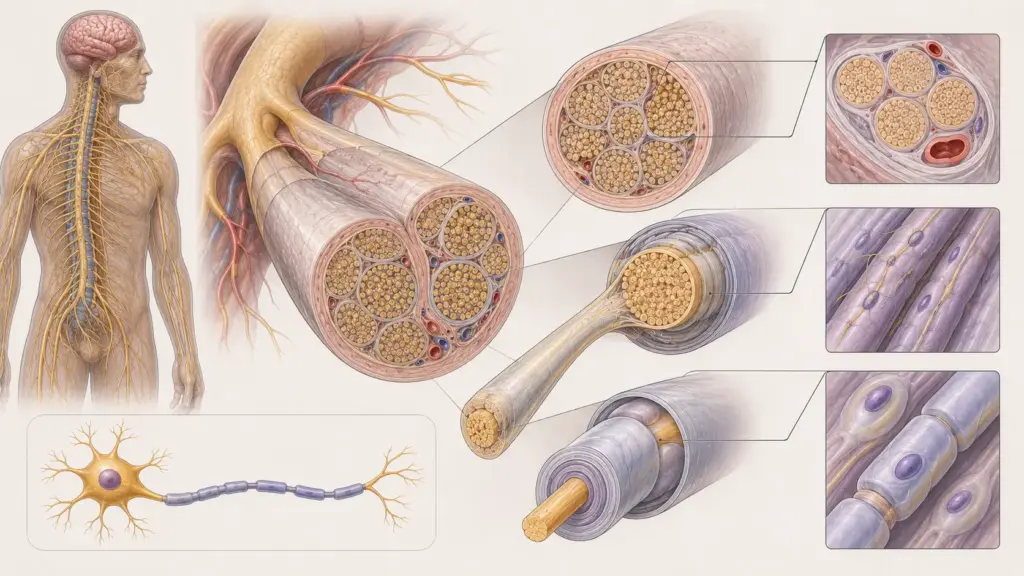
Peripheral nerve sheath tumors are neoplasms originating from Schwann cells, fibroblasts, and perineural cells of the peripheral nervous system. These tumors can be benign or malignant. Among the benign forms, schwannoma (neurolemoma) and neurofibroma are the most common. Malignant peripheral nerve sheath tumors (MPNST) is an aggressive type of sarcoma that arises from peripheral nerves or existing neurofibromas. Early diagnosis and complete surgical resection directly influence treatment success in both benign and malignant forms.
What Is a Peripheral Nerve Sheath Tumor?
Peripheral nerve sheath tumors are neoplasms that develop from the supporting tissue of peripheral nerves. Benign forms can originate from any cell type in the nerve sheath. A schwannoma is a encapsulated, slow-growing tumor that originates from Schwann cells. A neurofibroma, on the other hand, is a non-encapsulated, more diffuse lesion that grows within the nerve fibers. Both types typically present as painless, slow-growing masses.
Malignant peripheral nerve sheath tumor (MPNST) accounts for 5–10% of all soft tissue sarcomas, with an annual incidence of approximately 1 per 1,000,000 people. MPNSTs can develop spontaneously or in association with neurofibromatosis type 1 (NF1). The risk of developing MPNST in patients with NF1 is 8–13%; this risk is 2.5to 4 times higher than in the general population. MPNSTs have an aggressive course, exhibit local invasion, and can metastasize to distant sites.
Symptoms of Peripheral Nerve Sheath Tumors
Symptoms of peripheral nerve sheath tumors vary depending on the tumor type, size, location, and nerve compression:
- Palpable mass: A slow-growing, painless or mildly painful mass under the skin; typical of schwannomas.
- Pain: Stabbing, burning, or electric shock-like pain due to nerve compression; may worsen at night.
- Paresthesia and numbness: Tingling, prickling, or numbness in the area innervated by the nerve compressed by the tumor.
- Muscle weakness: Weakness in the affected muscle groups due to motor nerve involvement.
- Tinel’s sign: A sensation of an electric shock in the nerve distribution area when the tumor is tapped.
Symptoms are more aggressive in MPNSTs. The mass grows rapidly, pain intensifies, and night pain is prominent. The tumor may invade deep tissues, and regional lymph node involvement may occur. In patients with NF1, a sudden increase in the size of existing neurofibromas, a change in pain, or hardening should raise suspicion of MPNST transformation.
Treatment of Peripheral Nerve Sheath Tumors
Treatment for peripheral nerve sheath tumors is personalized based on the tumor type (benign or malignant), size, location, and nerve function:
Treatment of Benign Tumors
- Observation (Follow-up): For asymptomatic, small, slow-growing schwannomas and neurofibromas, follow-up with an MRI every 6–12 months may be sufficient.
- Surgical Excision: This is the gold standard for symptomatic, growing, or nerve-function-impairing benign tumors. Schwannomas can be excised by separating them from the nerve sheath; however, because neurofibromas are more diffuse, resection while preserving nerve function may be difficult.
- Radiotherapy: It may be used judiciously in cases where complete surgical resection is not possible or in recurrent benign tumors.
Treatment of Malignant Peripheral Nerve Sheath Tumors (MPNST)
- Surgical Resection: R0 resection (microscopically negative margins) is the only potentially curative treatment. According to Mayo Clinic data, the 10-year survival rate is 65% in patients with an R0 margin, while this rate drops to 41% for R1/R2 margins.
- Radiotherapy: It is used as adjuvant therapy in high-stage lesions or cases with positive surgical margins. With brachytherapy, the 5-year local control rate can reach 88%; with external beam radiation therapy, this rate is 51%.
- Chemotherapy: It is used in metastatic or recurrent disease. Doxorubicin plus ifosfamide is the most commonly used regimen; the objective response rate is 21%, and the median progression-free survival is 17 weeks.
- Targeted Therapies: MEK inhibitors (selumetinib) are being evaluated in clinical trials for MPNSTs with NF1 mutations. Agents such as nirogacestat (a γ-secretase inhibitor) and pazopanib (a VEGFR inhibitor) show limited response.
- Immunotherapy: The response rate to immunotherapy in MPNSTs is low; clinical trials are ongoing.
| Treatment Modality | Indication | Expected Outcome |
|---|---|---|
| Surgery (R0) | Localized MPNST | 10-year OS 65% |
| Surgery (R1/R2) | Positive Margins | 10-Year OS 41% |
| Adjuvant Radiotherapy | Advanced Stage, positive margins | Local control 51–88% |
| Systemic Chemotherapy | Metastatic/recurrent | ORR 21%, mPFS 17 weeks |
| MEK Inhibitors | NF1 mutation (clinical trial) | Stable disease 43% |
According to Assoc. Prof. Dr. Nilay Şengül, achieving R0 resection is the most critical prognostic factor in MPNST treatment; therefore, performing the initial surgery for the tumor at an experienced sarcoma center directly impacts both local control and survival.
Clinical Assessment by Assoc. Prof. Dr. Nilay Şengül
In my clinical practice, I frequently observe the following: A significant proportion of patients diagnosed with a peripheral nerve sheath tumor neglect the mass for a long time, mistaking it for a “lipoma” or “cyst.” Especially in tumors with deep locations, such as the thigh and arm, the risk of nerve function loss and malignant transformation increases as diagnosis is delayed. According to Assoc. Prof. Dr. Nilay Şengül, every deep soft tissue mass should be evaluated with MRI, and the diagnosis should be confirmed by biopsy in cases of suspicious lesions; in early-stage benign tumors, nerve-sparing surgery optimizes both functional outcomes and reduces the risk of malignant transformation. This approach highlights the vital importance of regular mass monitoring, particularly in patients with NF1.
From Diagnosis to Recovery: How Does the Process Proceed?
The diagnosis and treatment process for peripheral nerve sheath tumors progresses in stages based on the patient’s clinical condition:
- Initial Examination and Evaluation: A detailed medical history is taken from patients presenting with suspected peripheral nerve sheath tumors. The rate of tumor growth, the nature of the pain, and the (numbness, tingling, muscle weakness) are assessed. A history of NF1 (café-au-lait spots, axillary freckling, family history of neurofibromatosis) is evaluated. During the physical examination, the size, mobility, and firmness of the mass, as well as Tinel’s sign and any loss of motor or sensory function, are assessed.
- Tests and Imaging: Magnetic resonance imaging (MRI) is the gold standard for characterizing nerve sheath tumors. T1- and T2-weighted sequences, contrast-enhanced imaging, and diffusion MRI assess the tumor’s borders, nerve involvement, and suspicion of malignancy. A biopsy (fine-needle aspiration or open biopsy) confirms the diagnosis; biopsy is mandatory, particularly when MPNST is suspected. PET-CT is helpful in assessing metabolic activity and distant metastases in MPNSTs.
- Treatment Planning: The findings are reviewed by a multidisciplinary sarcoma board (orthopedic oncologist, medical oncologist, radiation oncologist, radiologist, pathologist). For benign tumors, surgical excision is planned for symptomatic or growing lesions. For MPNSTs, staging (AJCC system) is performed; R0 resection is the goal for localized disease. Neoadjuvant chemotherapy or radiation therapy is considered for large or borderline resectable tumors.
- Surgical Procedure and Hospital Stay: Surgery for peripheral nerve sheath tumors is performed under general anesthesia. Schwannomas are removed by microscopically dissecting them from the nerve sheath; since neurofibromas are more diffuse, nerve-sparing techniques are used. In MPNSTs, wide local excision or amputation (in cases of limb involvement, if R0 is not possible) may be performed. The length of hospital stay is 2–7 days, depending on the extent of the surgery. Postoperative nerve function, pain control, and wound care are closely monitored.
- Post-Discharge Recovery: In benign tumors, full recovery occurs within 2–4 weeks; nerve function improves gradually. For MPNSTs, adjuvant therapy (chemotherapy and/or radiation therapy) is initiated 4–6 weeks after surgery. Rehabilitation, physical therapy, and occupational therapy are used to support the recovery of motor function. As part of the follow-up plan, MRI follow-up is recommended every 6–12 months for benign tumors; for MPNSTs, every 3 months for the first 2 years, and every 6 months thereafter. Regular skin and nerve examinations are of vital importance in patients with NF1.
According to Assoc. Prof. Dr. Nilay Şengül, during the follow-up period after MPNST treatment, clinical and imaging follow-up every 3–6 months is critical for the early detection of newly developing masses and changes in existing neurofibromas, particularly in patients with NF1; the recurrence rate for MPNSTs ranges from 30% to 70%.
Frequently Asked Questions
Is a benign peripheral nerve sheath tumor benign?
Yes, a benign peripheral nerve sheath tumor is benign. Schwannomas and neurofibromas are the most common benign forms. These tumors grow slowly, do not invade surrounding tissues, and do not metastasize. Most patients are asymptomatic or may experience mild pain and numbness. The risk of recurrence after complete surgical excision is low; however, because neurofibromas have a diffuse structure, complete removal can be difficult, and they may be prone to recurrence.
Is a malignant peripheral nerve sheath tumor fatal?
Malignant peripheral nerve sheath tumor (MPNST) has a serious prognosis, but there is a chance of survival with early diagnosis and complete surgical resection. According to NCI data, the 5-year survival rate ranges from 23% to 69%; this wide range depends on the tumor stage, size, and the status of surgical margins. In localized patients who undergo R0 resection, the 10-year survival rate reaches 65%. However, the prognosis is poor in metastatic disease. The prognosis for MPNSTs associated with NF1 may be lower than that for sporadic cases.
Peripheral nerve sheath tumors present a broad clinical spectrum, ranging from benign (schwannoma, neurofibroma) to malignant (MPNST) forms. Benign tumors generally have a benign course and can be treated surgically. MPNST, on the other hand, is an aggressive sarcoma, and early diagnosis and R0 surgical resection are the most important prognostic factors. The risk of developing MPNST is significantly increased in patients with NF1; therefore, regular follow-up is of vital importance. Treatment involves a multidisciplinary combination of surgery, radiation therapy, chemotherapy, and targeted therapies.
To discuss your specific situation regarding peripheral nerve sheath tumors and have your questions answered, you can consult with Assoc. Prof. Dr. Nilay Şengül. To schedule an appointment at the Memorial Şişli Hospital clinic, please call 444 7 888.
Sources
- PMC/NIH, “Outcomes of Treatment for Malignant Peripheral Nerve Sheath Tumors: Different Clinical Features Associated with Neurofibromatosis Type 1” — https://pmc.ncbi.nlm.nih.gov/articles/PMC5512378/
- PMC/NIH, “Malignant Peripheral Nerve Sheath Tumors: Latest Concepts in Disease Pathogenesis and Clinical Management” — https://pmc.ncbi.nlm.nih.gov/articles/PMC9954030/
- Mayo Clinic, “Nerve sheath tumors – Diagnosis and treatment” — https://www.mayoclinic.org/diseases-conditions/nerve-sheath-tumors/diagnosis-treatment/drc-20594704
- Cleveland Clinic, “Malignant Peripheral Nerve Sheath Tumor (MPNST)” — https://my.clevelandclinic.org/health/diseases/malignant-peripheral-nerve-sheath-tumor-mpnst
- MDPI/Cancers, “Challenges and Progress for the Treatment of Malignant Peripheral Nerve Sheath Tumors in the Context of Recent Successes in Sarcoma Therapy” — https://www.mdpi.com/2072-6694/17/23/3781
- NCI, “Malignant Peripheral Nerve Sheath Tumors (MPNST)” — https://www.cancer.gov/pediatric-adult-rare-tumor/rare-tumors/rare-soft-tissue-tumors/malignant-peripheral-nerve-sheath-tumor