📌 What You Need to Know in a Nutshell
- Lung cancer ranked first in cancer deaths in the U.S. in 2023with 228,058 new cases and 128,663 deaths in 2024, making it the leading cause of cancer deaths; smoking is the most significant and preventable risk factor.
- In early-stage (localized) non-small cell lung cancer (NSCLC), the 5-year survival rate reaches 67%, while in advanced-stage (metastatic) NSCLC, this rate drops to 12%; approximately half of all cases are diagnosed at an advanced stage.
- Low-dose CT screening (LDCT) enables early diagnosis in high-risk smokers aged 50–80 and reduces mortality by 20%.
- Immunotherapy and targeted therapies have significantly prolonged survival in advanced-stage NSCLC; pembrolizumab monotherapy has increased 5-year survival to 31.9% in patients with high PD-L1 expression.
Lung cancer is a cancer that originates in lung cells and is one of the most common cancers worldwide. In the United States, it is the leading cause of cancer deaths in both men and women. Because it often progresses silently in its early stages, the vast majority of patients are diagnosed at an advanced stage. However, low-dose CT (LDCT), immunotherapy, and targeted therapies have significantly improved survival rates.
What Is Lung Cancer?
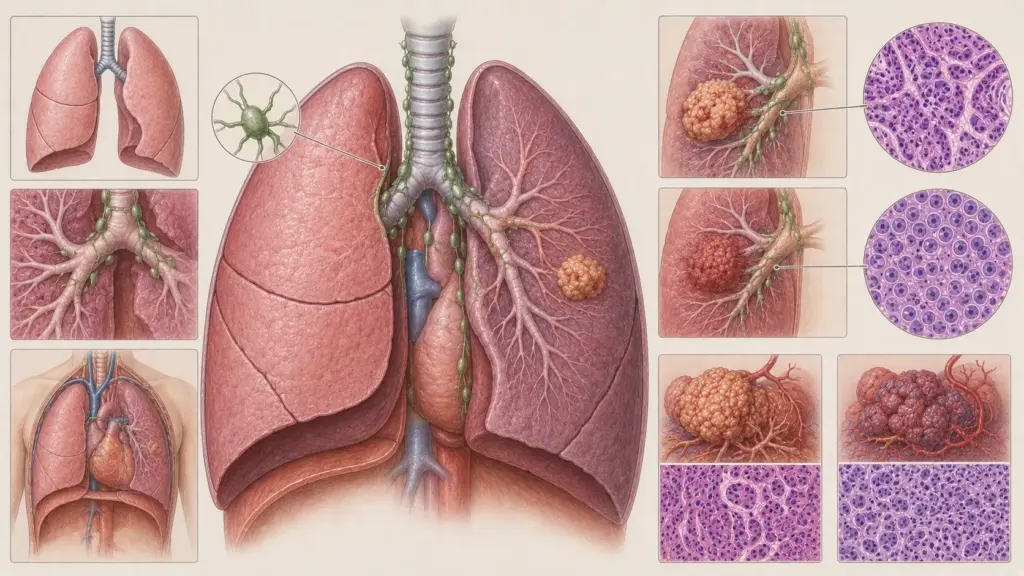
Lung canceris a malignant tumor originating from lung cells and characterized by uncontrolled proliferation. Lung cancer is divided into two main groups: non-small cell lung cancer (NSCLC) and small cell lung cancer (SCLC). NSCLC accounts for 85% of all cases and is subdivided into adenocarcinoma, squamous cell carcinoma, and large cell carcinoma. SCLC accounts for 15% of cases and has a more aggressive course.
According to CDC U.S. Cancer Statistics, 228,058 new cases of lung cancer were reported in the U.S. in 2023, and 128,663 people died from the disease in 2024. According to American Cancer Society projections for 2025, 226,650 new cases of lung cancer and 124,730 deaths are projected for 2025. Lung cancer accounts for approximately 20% of cancer deaths and causes 2.5 times more deaths than colon cancer.
According to Assoc. Prof. Dr. Nilay Şengül, the most critical factor in the diagnosis of lung cancer is early detection; because while the 5-year survival rate is 67% in the localized stage, this rate drops to 12% in the advanced stage. For this reason, low-dose CT screening (LDCT) is of life-saving importance.
What Causes Lung Cancer? Risk Factors
Smoking is the most significant and preventable risk factor for the development of lung cancer. According to CDC data, 80–90% of lung cancer cases are related to smoking. Other important risk factors include:
- Smoking: This is the most significant cause; secondhand smoke also increases the risk. According to data from the American Cancer Society, 85% of lung cancer deaths in 2025 will be directly attributable to smoking.
- Radon gas: A naturally occurring radioactive gas; it can accumulate in homes and is the second leading cause of lung cancer.
- Asbestos exposure: Occupational exposure increases the risk of lung cancer and mesothelioma.
- Air pollution: Particulate matter (PM2.5) and other pollutants increase the risk.
- Family history: A history of lung cancer in a first-degree relative increases the risk.
- Previous lung disease: COPD, tuberculosis, and pulmonary fibrosis may increase the risk.
- Ionizing radiation: Radiation therapy to the chest area increases the risk.
Protective factors include quitting smoking (the risk returns to near-normal levels 10–15 years after quitting), radon testing and mitigation, use of occupational protective equipment, and a healthy lifestyle. According to data from the American Cancer Society, the prevalence of smoking dropped from 42% in 1965 to 12% in 2022; this decline is is the primary cause of the decline in lung cancer incidence and mortality.
What Are the Symptoms of Lung Cancer?
Early-stage lung cancer is usually asymptomatic; therefore, screening is critical. By the time symptoms appear, the disease is often in an advanced stage. The most common symptoms are:
- Persistent cough: A cough that lasts longer than 2–3 weeks, remains unchanged, or worsens.
- Blood in sputum (hemoptysis): Blood or rust-colored discharge in sputum.
- Chest pain: Pain that worsens with coughing, breathing, or laughing.
- Shortness of breath: Shortness of breath during activities that were previously manageable.
- Weight loss and loss of appetite: Unexplained weight loss.
- Hoarseness: Due to recurrent laryngeal nerve involvement.
- Swelling of the face and neck: A sign of superior vena cava (SVC) syndrome.
- Recurrent infections: Recurrent bronchitis or pneumonia.
Assoc. Prof. Dr. Şengül emphasizes that in her clinical practice, approximately 60% of patients diagnosed with lung cancer present with “persistent cough and bloody sputum” as their initial complaint. These symptoms, must be evaluated without fail, especially in individuals with a history of smoking, if they persist for more than 2 weeks. Additionally, systemic symptoms such as weight loss and loss of appetite are signs of advanced-stage lung cancer.
| Symptom | Frequency | Severity |
|---|---|---|
| Persistent cough | Most common | High — when it lasts longer than 2–3 weeks |
| Blood-tinged sputum | Frequent | Very high — requires immediate evaluation |
| Chest pain | Frequent | Moderate to high |
| Shortness of breath | Frequent | Moderate to severe |
| Weight loss | Moderate | High — a sign of advanced stage |
How Is Lung Cancer Diagnosed? The Diagnostic Process
Lung cancer is diagnosed through clinical examination, imaging, biopsy, and molecular testing. Screening programs enable the detection of asymptomatic masses at an early stage in high-risk individuals.
Screening
The U.S. Preventive Services Task Force (USPSTF) recommends annual low-dose CT (LDCT) screening for individuals aged 50–80 with a history of 20 pack-years or more of smoking who are current smokers or have quit within the past 15 years. LDCT screening has reduced lung cancer mortality by 20%. LDCT screening could also be considered for similar risk groups in Turkey.
Diagnostic Process
- Medical History and Physical Examination: Smoking history, occupational exposure, family history, and symptoms are assessed in detail.
- Imaging: A chest X-ray is the first step; if suspicious findings are present, a chest CT (with contrast) is ordered. PET-CT is used to evaluate lymph nodes and distant metastases.
- Biopsy: Tissue samples are obtained via bronchoscopy, EBUS (endobronchial ultrasound), mediastinoscopy, or CT-guided transthoracic biopsy. This is the gold standard for diagnosis.
- Pathological evaluation: The distinction between NSCLC and SCLC, as well as subtype and grade, is assessed.
- Molecular tests: In NSCLC, biomarkers such as EGFR, ALK, ROS1, BRAF, MET, RET, KRAS, and PD-L1 are tested; these tests determine the selection of targeted therapy.
According to Assoc. Prof. Dr. Nilay Şengül, the most significant cause of diagnostic delay in lung cancer is patients attributing their symptoms to “smoking-related” or a “winter illness.” Especially in current or former smokers, a cough lasting longer than 2–3 weeks and bloody sputum must be evaluated.
Types of Lung Cancer
Lung cancer is divided into two main groups based on histological and molecular characteristics. This classification directly influences treatment strategies and prognosis.
| Characteristic | NSCLC (85%) | SCLC (15%) |
|---|---|---|
| Cell Type | Adenocarcinoma, squamous, large cell | Small, round, blue cells |
| Growth rate | Slow to moderate | Very fast |
| Metastasis | Later | Early and widespread |
| Surgery | Possible in early stages | Rarely (very early stage) |
| Treatment | Surgery, chemotherapy, immunotherapy, targeted therapy | Chemoradiotherapy, immunotherapy (limited) |
| 5-year survival | 32% (all stages) | 9% (all stages) |
Among NSCLC subtypes, adenocarcinoma is the most common (40%) and typically occurs peripherally (at the outer edge of the lung). Squamous cell carcinoma (25–30%) is usually centrally located (in the large bronchi) and is strongly associated with smoking. SCLC is a centrally located, grows rapidly, and metastasizes early.
Stages of Lung Cancer
Lung cancer staging is performed according to the 8th edition of the AJCC (American Joint Committee on Cancer) guidelines. The stage is determined based on tumor size (T), lymph node involvement (N), and distant metastasis (M). Staging differs for NSCLC and SCLC.
| Stage | Definition | 2-Year Survival Rate | 5-Year Survival |
|---|---|---|---|
| IA1 | Tumor ≤1 cm | 97% | 90% |
| IA2 | Tumor 1–2 cm | 94% | 85% |
| IA3 | Tumor 2–3 cm | 92% | 80% |
| IB | Tumor 3–4 cm | 89% | 73% |
| IIA | Tumor 4–5 cm or invasion | 82% | 65% |
| IIB | Tumor >5 cm or N1 | 76% | 56% |
| IIIA | N2 lymph node | 65% | 41% |
| IIIB | N3 lymph node or T3-4 invasion | 47% | 24% |
| IIIC | Widespread N3 or T4 invasion | 30% | 12% |
| IVA | Single-organ metastasis | %23 | %10 |
| IVB | Multiorgan metastasis | 10% | 0% |
According to CDC data, the stage distribution for lung cancer is as follows: Localized stage accounts for less than 28%, regional stage for 22%, and distant (metastatic) stage for 48%. Approximately half of patients are diagnosed at the distant stage; this directly affects survival. The overall 5-year survival rate for NSCLC is 32%, and for SCLC,is 9%. While the 5-year survival rate for lung cancer was 12% between 1975 and 1977, it rose to 27% between 2014 and 2020; this improvement is due to immunotherapy and targeted therapies.
Lung Cancer Treatment
Lung cancer treatment is personalized based on the stage, histological type (NSCLC/SCLC), molecular profile, and the patient’s overall condition. A multidisciplinary approach (thoracic surgery, medical oncology, radiation oncology, pathology, radiology, pulmonology) is standard.
NSCLC Treatment
Early-stage (I-II): Surgical resection (lobectomy, pneumonectomy) is the primary treatment. Video-assisted thoracoscopic surgery (VATS) and robotic surgery are less invasive than open surgery. Adjuvant chemotherapy (cisplatin-based) is recommended for stage IB and above. In stages II–III, adjuvant immunotherapy (atezolizumab, pembrolizumab) prolongs survival.
Locally advanced stage (III): Concurrent chemoradiotherapy (CCRT) is the standard treatment. The PACIFIC trial demonstrated that durvalumab (Imfinzi) consolidation therapy following CCRT increased 5-year survival to 42.9% (placebo 33.4%).
Metastatic stage (IV): Treatment is personalized based on the molecular profile:
- EGFR mutation: Osimertinib (Tagrisso) is the first-line treatment; the FLAURA trial increased median PFS to 18.9 months.
- ALK translocation: Alectinib (Alecensa) is the first-line treatment; the ALEX trial increased median PFS to 34.8 months.
- High PD-L1 (≥50%): Pembrolizumab (Keytruda) monotherapy; the KEYNOTE-024 trial increased 5-year overall survival to 31.9% (compared to 16.3% with chemotherapy).
- Low/negative PD-L1: Pembrolizumab + chemotherapy combination.
- Chemotherapy: Platinum + paclitaxel/pemetrexed combinations.
SCLC Treatment
Stage I (limited): Surgery + adjuvant chemotherapy (rarely).
Stage II–III (limited): Concurrent chemoradiotherapy (cisplatin + etoposide + chest radiation therapy).
Stage IV (extensive): Chemotherapy (cisplatin/carboplatin + etoposide) + immunotherapy (atezolizumab or durvalumab). The CASPIAN study demonstrated that the addition of durvalumab increased median OS from 10.3 months to 13.0 months.
According to Assoc. Prof. Dr. Nilay Şengül, the most critical determinant of treatment success in lung cancer is “molecular profiling”; that is, performing comprehensive biomarker testing in every advanced-stage NSCLC patient directly influences treatment selection. For example, while a patient with an EGFR mutation receives osimertinib, a high proportion of patients with PD-L1 a patient with high PD-L1 expression receives immunotherapy. For this reason, completing a broad molecular panel at the time of diagnosis is mandatory.
Lung Cancer Surgery: What to Expect?
Lung cancer surgery is planned with varying scopes depending on the tumor stage, location, and the patient’s respiratory function. The primary goal is complete removal of the tumor (R0 resection).
Preoperative: Prior to hospital admission, blood tests, an ECG, a chest X-ray, CT, PET-CT, pulmonary function tests (SPIR), and a cardiac evaluation are performed. Anticoagulant medications are discontinued before surgery.
Surgical procedure: The procedure is performed under general anesthesia. Lobectomy (removal of a lobe) is the most commonly preferred approach. Pneumonectomy (removal of the entire lung), segmentectomy, or wedge resection (sublobar) are other options. VATS (video-assisted thoracoscopic surgery) and robotic surgery offer less pain, a shorter hospital stay, and faster recovery compared to open surgery. The surgery typically lasts 2–5 hours.
Postoperative Care: The hospital stay is 3–5 days for VATS and 5–7 days for open surgery. A chest tube (drain) may remain in place for 2–5 days. Pain management (epidural or PCA), breathing exercises (incentive spirometer), and early mobilization are priorities. The risk of heart failure is high following pneumonectomy; therefore, fluid balance is carefully managed.
Assoc. Prof. Dr. Şengül notes that the most common issues encountered in clinical practice following lung cancer surgery are “postoperative pain and impaired respiratory function.” Epidural anesthesia and regular breathing exercises are critical in preventing these complications. Additionally, quitting smoking before surgery significantly improves wound healing and respiratory function.
Clinical Assessment by Assoc. Prof. Dr. Nilay Şengül
In my clinical practice, I frequently observe the following: Approximately half of patients diagnosed with lung cancer are found to be in an advanced stage (metastatic) stage, and this directly affects treatment options and outcomes. According to Assoc. Prof. Dr. Nilay Şengül, the most critical factor in lung cancer is “early screening”; annual low-dose CT screening (LDCT) in high-risk individuals (those with a history of heavy smoking) has reduced the mortality rate by 20%, and this effect is more pronounced than that of breast cancer screening.
Furthermore, in advanced-stage NSCLC, immunotherapy and targeted therapies have fundamentally transformed the treatment paradigm. Pembrolizumab monotherapy has increased 5-year survival to 31.9%31.9% in patients with high PD-L1 expression; this rate represents nearly a twofold increase compared to chemotherapy. Therefore, comprehensive molecular testing (NGS panel) is essential for treatment success.
From Diagnosis to Recovery: How Does the Process Proceed?
- Initial examination and medical history: During the initial pulmonology or thoracic surgery examination, cough, sputum, shortness of breath, weight loss, and smoking history are thoroughly assessed. Family history and occupational exposure are documented.
- Tests and imaging: Chest X-ray, chest CT, PET-CT, and brain MRI are ordered. A sample is obtained from the suspicious lesion via bronchoscopy, EBUS, or transthoracic biopsy. Blood tests (complete blood count, biochemistry, coagulation) are performed.
- Pathology and molecular testing: The biopsy specimen is evaluated to distinguish NSCLC from SCLC and to determine the subtype and grade. In NSCLC, biomarkers such as EGFR, ALK, ROS1, BRAF, MET, RET, KRAS, and PD-L1 are tested.
- Treatment planning: The stage, molecular profile, and treatment strategy are determined during a multidisciplinary tumor board meeting (thoracic surgeon, medical oncologist, radiation oncologist, pathologist, radiologist).
- Surgical/systemic treatment: In early stages, VATS or open lobectomy/pneumonectomy is performed. In advanced stages, chemotherapy, immunotherapy, or targeted therapy is administered.
- Recovery and follow-up: Follow-up is recommended every 3 months for the first 2 years, every 6 months from years 3 to 5, and annually after the 5th year. Follow-up includes chest CT, PET-CT, and other imaging as needed. In the event of a recurrence, second-line treatment or participation in a clinical trial is considered.
According to Assoc. Prof. Dr. Nilay Şengül, the first 2 years are the most critical period for follow-up after lung cancer treatment, as most recurrences occur during this time. Regular chest CT follow-up enables the early detection of recurrence and intervention. Additionally, post-treatment respiratory function rehabilitation and support for smoking cessation are important for maintaining quality of life.
Frequently Asked Questions
Does lung cancer cause pain?
Early-stage lung cancer is generally painless. Pain usually occurs in advanced stages as a result of the tumor spreading to the chest wall, spine, or adjacent structures. Chest pain may worsen with coughing, breathing, or laughing. Bone metastases (spine, ribs) can cause severe bone pain.
Is lung cancer contagious?
Lung cancer itself is not contagious. However, smoking and secondhand smoke can increase the risk among family members. Exposure to radon gas can also be shared among household members. Lung cancer does not spread directly from one person to another; however, risk factors are related to environmental and behavioral factors.
How many stages are there in lung cancer?
Lung cancer is staged from 0 to IVB according to the 8th edition of the AJCC (0, IA1-3, IB, IIA, IIB, IIIA, IIIB, IIIC, IVA, IVB). In NSCLC, staging is based on the TNM (tumor, node, metastasis) system. In SCLC, however, limited and extensive staging is used. The stage directly affects the treatment strategy and prognosis.
How many years does it take for lung cancer to progress?
The rate of progression of lung cancer varies depending on the tumor type. SCLC grows very rapidly and can progress within months. NSCLC grows more slowly; however, some subtypes, such as adenocarcinoma, can be aggressive. Generally, it can take 3–6 months from the onset of symptoms to diagnosis; however, this timeframe varies from person to person.
How long does it take for lung cancer to be fatal?
The prognosis for lung cancer varies depending on the stage and tumor type. While the 5-year survival rate is 90% in early-stage (IA1) disease, it is 0% in advanced-stage (IVB) disease. The overall 5-year survival rate is 32% for NSCLC and 9% for SCLC. Immunotherapy and targeted therapies have significantly extended survival in advanced stages; pembrolizumab monotherapy has increased the 5-year survival rate to 31.9% in patients with high PD-L1 expression.
Is lung cancer fatal?
Lung cancer is the leading cause of cancer deaths in both men and women in the U.S. In 2024, 128,663 deaths were reported. However, in early-stage (localized) 5-year survival reaches 67%, and curative treatment is possible. In advanced stages, it is treatable but not curable; the goal is to extend life expectancy and maintain quality of life.
Is lung cancer treatable?
Early-stage lung cancer (IA-IB) can be treated curatively with surgery; the 5-year survival rate ranges from 73% to 90%. In advanced stages (III-IV) is treatable but not curable. Immunotherapy and targeted therapies have significantly extended survival in advanced-stage NSCLC. Treatment options for SCLC are more limited; however, with chemoradiotherapy plus immunotherapy, median survival can reach 13 months.
How long does lung cancer treatment take?
Early-stage surgical treatment is completed in a single session; recovery takes 4–6 weeks. Adjuvant chemotherapy lasts 3–4 months, and adjuvant immunotherapy lasts 1 year. Advanced-stage systemic treatment (chemotherapy, immunotherapy, targeted therapy) is administered continuously or intermittently; the treatment duration may be 6–12 months or longer, depending on the response. Targeted therapies (osimertinib) are generally continued until disease progression.
How is lung cancer screening performed?
Annual low-dose CT (LDCT) screening is recommended. For diagnosis, chest CT, PET-CT, bronchoscopy, EBUS, or transthoracic biopsy are performed. Pathological examination and molecular testing (EGFR, ALK, PD-L1, etc.) are performed on the biopsy specimen. Pulmonary function tests and cardiac evaluation are used to determine surgical eligibility.
Lung cancer is one of the most common cancers worldwide and one of the leading causes of death. In the United States, 228,058 new cases were reported in 2023, and 128,663 deaths were reported in 2024. Smoking is the most significant and preventable risk factor; the decline in smoking prevalence is the primary reason for the decrease in lung cancer mortality.
While the 5-year survival rate is 67% in early-stage (localized) disease, it drops to 12% in advanced-stage (metastatic) disease. Low-dose CT screening (LDCT) has reduced the mortality rate by 20%20 percent. Treatment is personalized based on stage and molecular profile (EGFR, ALK, PD-L1); combinations of surgery, chemotherapy, immunotherapy, and targeted therapy are used.
To assess your personal situation regarding lung cancer and have your questions answered, you can consult Assoc. Prof. Dr. Nilay Şengül. To schedule an appointment at Memorial Şişli Hospital, please call 444 7 888.
Sources
- CDC, U.S. Cancer Statistics, “Lung Cancer Stat Bite” — https://www.cdc.gov/united-states-cancer-statistics/publications/lung-cancer-stat-bite.html
- Siegel RL et al., CA: A Cancer Journal for Clinicians, “Cancer Statistics, 2025” — https://pmc.ncbi.nlm.nih.gov/articles/PMC11745215/
- WebMD, “Lung Cancer Survival Rates & Stages” — https://www.webmd.com/lung-cancer/lung-cancer-survival-rates
- USPSTF, “Screening for Lung Cancer” — https://www.uspreventiveservicestaskforce.org/uspstf/recommendation/lung-cancer-screening
- NCCN, “Non-Small Cell Lung Cancer, Version 3.2025, NCCN Clinical Practice Guidelines in Oncology” — https://jnccn.org/view/journals/jnccn/23/1/article-p1.xml
- ESMO, “Metastatic Non-Small Cell Lung Cancer: ESMO Clinical Practice Guideline” — https://www.esmo.org/guidelines/guidelines-by-topic/lung-and-chest-tumours