
At a Glance
- Genetic profiling analyses the molecular structure of the tumour using NGS (Next-Generation Sequencing) technology; hundreds of genes are screened in a single test to identify actionable mutations.
- With liquid biopsy (ctDNA), a tumour genetic profile can be obtained from a blood sample; this reduces the need for invasive biopsy and monitors treatment response in real time.
- Test results are reported within 714 days; the data obtained guide the options for targeted therapy, immunotherapy, and clinical trials.
- In Turkey, molecular tests for certain cancer types are on the reimbursement list under SGK coverage; broad panel tests are also available in private laboratories.
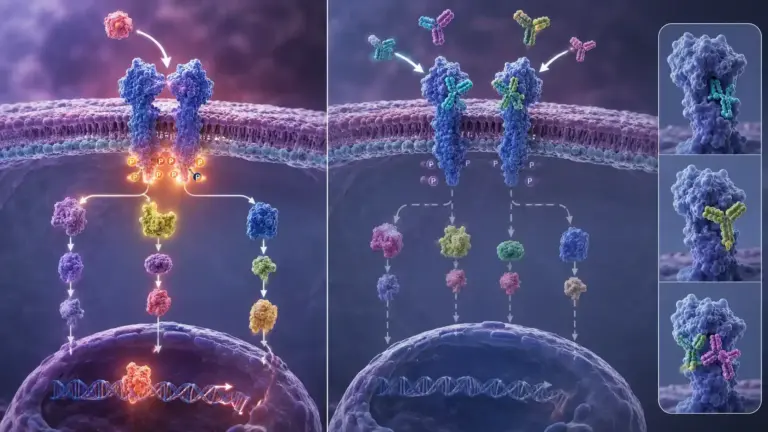
Genetic profiling is a molecular diagnostic method that personalises treatment decisions by analysing specific mutations, gene amplifications, and chromosomal rearrangements in the DNA of cancer cells. Going beyond conventional histopathological diagnosis, it explains the mechanisms of tumour growth and spread at the molecular level. According to NIH data, this approach has created a fundamental paradigm shift in cancer treatment over the past 15 years.
What Is Genetic Profiling?
Genetic profiling is the analysis of DNA and RNA obtained from tumour tissue or a blood sample using high-throughput sequencing technologies. Next-Generation Sequencing (NGS) simultaneously screens hundreds of genes in a single test to detect somatic mutations, copy number variations, and gene fusions. It is much faster, more sensitive, and more comprehensive than Sanger sequencing; an entire human genome can be sequenced in approximately one week.
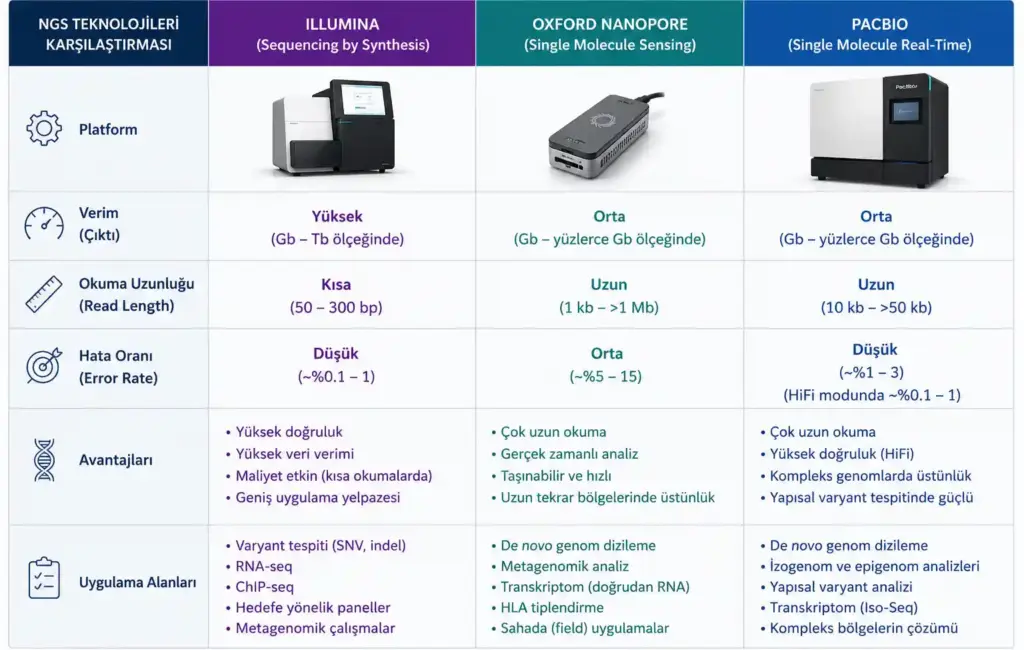
Among NGS platforms, Illumina (high throughput, low error rate 0.10.6%), Oxford Nanopore (ultra-long reads, real-time analysis), and PacBio (high-accuracy long reads) stand out. Each platform has different advantages in clinical and research applications. Illumina is the most widely used platform in clinical practice.
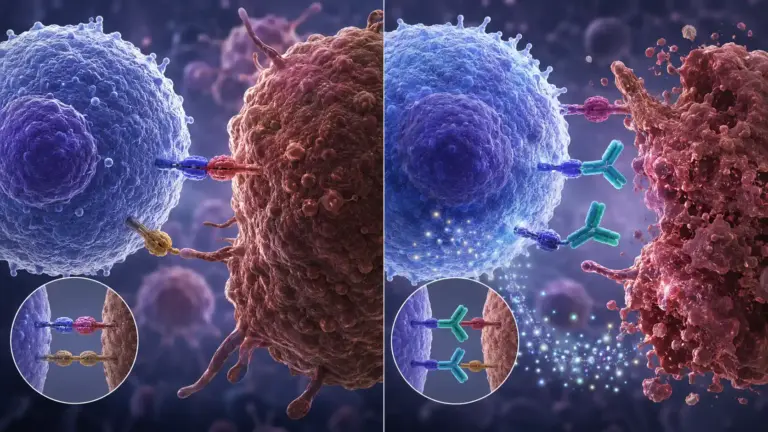
Test results determine tumour-specific molecular subtyping and actionable targets for the patient. For example, in lung cancer, an EGFR exon 19 deletion or L858R mutation can be treated with a third-generation TKI such as osimertinib. This allows a personalised strategy to be developed based on the molecular characteristics of the tumour, rather than the “same treatment for every patient” approach.
Who Is Genetic Profiling Applied To?
Genetic profiling has become a standard approach particularly in metastatic and advanced-stage cancers. According to Assoc. Prof. Dr Nilay Şengül, molecular testing is required in every patient with metastatic lung cancer and at the initial assessment stage in solid tumours such as breast cancer, colon cancer, and ovarian cancer; a decision on targeted therapy cannot be made without this test.
- Approved indications: Non-small cell lung cancer (NSCLC), breast cancer, colorectal cancer, ovarian cancer, prostate cancer, pancreatic cancer, biliary tract cancers, thyroid cancer, melanoma, haematological malignancies
- Stage and status: Predominantly in metastatic (Stage 4) disease; in early-stage high-risk subgroups or in neoadjuvant/adjuvant treatment planning it is also considered
- Required sample types: Formalin-fixed paraffin-embedded (FFPE) tumour tissue, fresh frozen biopsy specimen, blood (liquid biopsy/ctDNA), pleural/peritoneal fluid
- Gene panel screened: Small panel (50100 genes), medium panel (100300 genes), comprehensive panel (300+ genes); panel selection is determined by tumour type
How Is Genetic Profiling Performed?
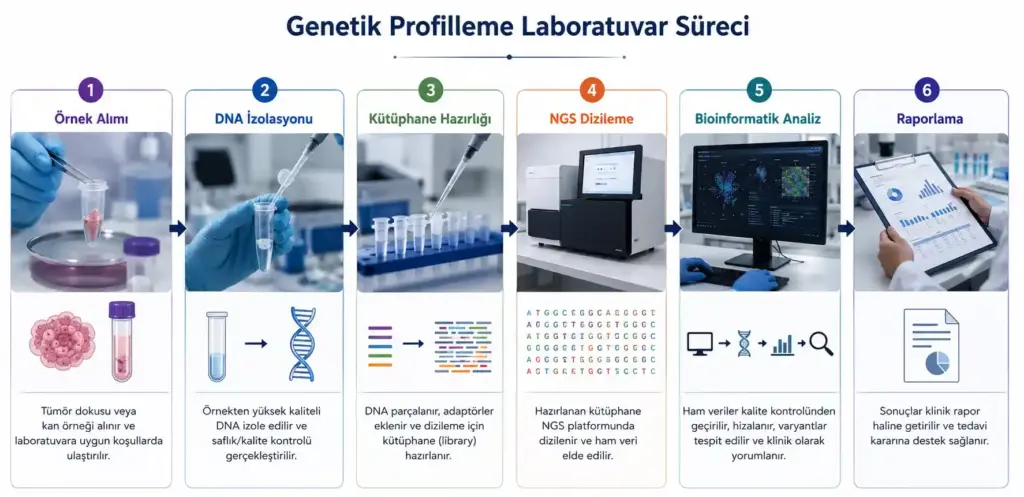
The genetic profiling process consists of several stages from sample collection to reporting:
- Sample collection: Tumour tissue biopsy (tru-cut, fine needle aspiration, excisional) or blood sample (liquid biopsy). FFPE blocks are the most commonly used sample type
- DNA/RNA isolation: Nucleic acid extraction from tumour cells in the laboratory; quality control is performed
- Library preparation: DNA fragments are cut to specific sizes, adapters are added, and they are prepared for sequencing
- Sequencing: Parallel sequencing on the NGS platform; takes 2448 hours for a medium-sized panel
- Bioinformatic analysis: Processing of raw data, variant calling, filtering, and classification according to clinical significance
- Reporting: A comprehensive report containing actionable mutations, clinical significance of variants, relevant clinical trials, and treatment recommendations
The entire process is completed within 714 working days; expedited reporting (35 days) may be possible in urgent situations. In the liquid biopsy (ctDNA) method, circulating tumour DNA in the blood is analysed; this method is particularly valuable in patients where invasive biopsy cannot be performed or tumour tissue is insufficient.
According to Assoc. Prof. Dr Nilay Şengül, the greatest strength of liquid biopsy is that it can be repeated during treatment and monitors resistance development in real time; this allows treatment change decisions to be made before radiological progression.
Genetic Profiling Results and Interpretation
The genetic profiling report classifies detected variants according to their clinical significance:
| Variant Class | Definition | Clinical Action |
|---|---|---|
| Tier I Actionable | Mutation associated with an approved targeted therapy or immunotherapy | Targeted therapy is initiated |
| Tier II Clinical Trial | Mutation associated with an experimental drug or clinical trial | Clinical trial is evaluated |
| Tier III Uncertain (VUS) | Variant of uncertain clinical significance | Monitored; literature is followed |
| Tier IV Incidental | Germline variant associated with hereditary cancer syndrome | Genetic counselling is recommended |
The most commonly screened actionable targets are: EGFR, ALK, ROS1, RET, MET, BRAF, KRAS G12C, HER2, NTRK, PIK3CA, BRCA1/2, MSI/dMMR, TMB. Each target has its own treatment option; for example, pembrolizumab is used in MSI-H/dMMR tumours, and larotrectinib or entrectinib in tumours with NTRK fusion.
Genetic Profiling and Treatment Planning
| Treatment Type | Biomarker | Example Application |
|---|---|---|
| Targeted therapy | EGFR, ALK, ROS1, RET, MET, BRAF, KRAS G12C, HER2, NTRK | Osimertinib in EGFR-mutant NSCLC; alectinib in ALK+ NSCLC |
| Immunotherapy | PD-L1, TMB (high), MSI-H/dMMR | Pembrolizumab in MSI-H colon cancer; immunotherapy in high TMB |
| Hormone therapy | ER/PR status, PIK3CA mutation | Alpelisib + fulvestrant in PIK3CA-mutant HR+ breast cancer |
| PARP inhibitors | BRCA1/2 mutation, HRD (homologous recombination deficiency) | Olaparib in BRCA-mutant ovarian cancer |
| Clinical trials | Rare mutations, new targets | Amivantamab clinical trials for EGFR exon 20 insertion |
Clinical Assessment by Assoc. Prof. Dr Nilay Şengül
I frequently observe the following in clinical practice: Thanks to genetic profiling, I see that patients who were previously labelled as “standard chemotherapy” have had actionable targets identified, completely changing their treatment and achieving much better responses. Particularly in lung cancer, I observe that patients in whom EGFR, ALK, or ROS1 positivity is detected by NGS panel have a 23-fold increase in median progression-free survival compared with chemotherapy.
According to Assoc. Prof. Dr Nilay Şengül, genetic profiling is an indispensable part of modern oncology; but the test itself is not sufficient correct interpretation and communication with the patient are also critical. At Memorial Şişli Hospital, we apply a routine NGS panel in every metastatic solid tumour case; through this, actionable targets are identified in 3040% of our patients and we shape our treatment strategy accordingly.
Frequently Asked Questions
What Is Genetic Profiling?
Genetic profiling is a diagnostic method that analyses the DNA and RNA of cancer cells to determine the molecular structure of the tumour. With NGS technology, hundreds of genes are screened in a single test; the data obtained guide the options for targeted therapy, immunotherapy, and clinical trials.
How Is the Genetic Test Performed?
The genetic test is performed with a tumour tissue biopsy (FFPE block) or blood sample (liquid biopsy). DNA/RNA is isolated in the laboratory, sequenced by NGS, and mutations are identified by bioinformatic analysis. Results are reported within 714 days.
When Are Genetic Test Results Available?
Standard NGS panel tests are completed in 714 working days. Expedited reporting (35 days) is possible in urgent situations. Liquid biopsy tests generally yield results within 510 days.
What Is Liquid Biopsy and How Is It Performed?
Liquid biopsy is a non-invasive method that determines the genetic profile of the tumour by analysing circulating tumour DNA (ctDNA) in the blood. It is performed with a standard blood draw (1020 mL); it reduces the need for invasive biopsy and monitors treatment response in a repeatable manner. However, it may not show equal sensitivity in all tumour types.
Genetic profiling is the cornerstone of the personalised approach in cancer treatment. Thanks to NGS and liquid biopsy technologies, the molecular structure of the tumour can be analysed in detail to determine the most appropriate treatment strategy. With the correct patient selection, comprehensive panel tests, and experienced interpretation, treatment success can be significantly improved.
You can consult Assoc. Prof. Dr Nilay Şengül to evaluate your personal situation regarding genetic profiling and to learn about your molecular testing options. To book an appointment at Memorial Şişli Hospital, you can call 444 7 888.
References
- Alsaiari AA, EXCLI Journal, 2025 Next-Generation Sequencing in Cancer: Genomic Profiling and Precision Therapy https://www.excli.de/…
- Ghoreyshi N et al., PMC/NIH, 2025 Next-generation sequencing in cancer diagnosis and treatment https://pmc.ncbi.nlm.nih.gov/articles/PMC12009796/
- Anagnostou V, ASCO Education, 2025 Liquid Biopsy Approaches https://ascopubs.org/…