
📌 What You Need to Know in a Nutshell
- Colon cancer (colorectal cancer) is the third most common cancer in the U.S., with 155,662 new cases annually; the 5-year survival rate is 65.4%.
- The 5-year survival rate reaches 91.3% in localized stages; in metastatic stages, this rate drops to 16.9%.
- FOLFOX (oxaliplatin + 5-FU + leucovorin) chemotherapy is the gold standard for adjuvant therapy in stage III colon cancer.
- Regular screening (fecal occult blood test, colonoscopy) for people aged 50–75 can increase the early diagnosis rate to 90%.
Colon cancer (colorectal cancer or colon carcinoma) is a malignant neoplasm originating from the mucosal layer of the large intestine (colon) and rectum. According to CDC data, 155,662 new cases were reported in the United States in 2023. According to SEER data, the 5-year relative survival rate is 65.4%. Early-stage diagnosis and appropriate treatment significantly improve survival.
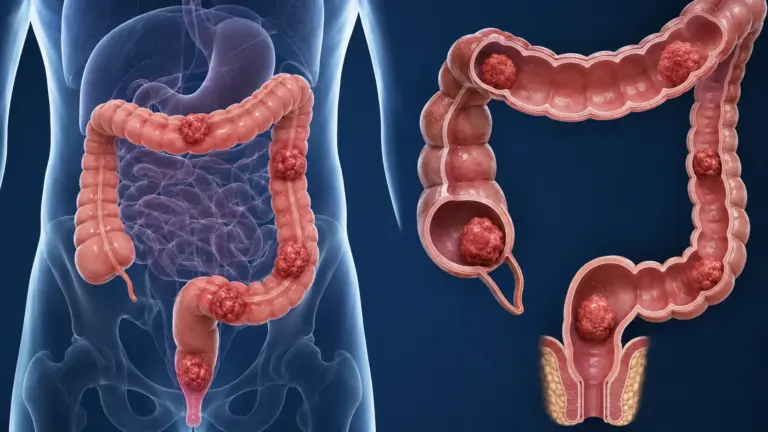
[VISUAL SUGGESTION: Schematic of colon anatomy and cancer regions—an anatomical infographic showing the ascending colon, transverse colon, descending colon, sigmoid colon, and rectum—Alt text: "Schematic of colon anatomy and colorectal cancer regions"]
What Is Colon Cancer (Colon Ca)?
Colon cancer is a malignancy that originates from the epithelial cells of the large intestine and most often develops from adenomatous polyps. The polyp-to-cancer sequence is the fundamental pathophysiological mechanism underlying the development of colorectal cancer. Adenomatous polyps can undergo dysplastic changes over the course of several years and transform into invasive carcinoma; this process typically takes 10–15 years.
According to SEER data, 34% of colorectal cancer cases are diagnosed at the localized stage, 37% at the regional stage, and 23% at the stage with distant metastases. According to CDC data, 54,468 people died from colorectal cancer in 2024. It is more common in men than in women; the lifetime risk of developing the disease is 3.9% for men and 3.6% for women.
According to Assoc. Prof. Dr. Nilay Şengül, the most critical step in the diagnosis of colon cancer is for individuals over the age of 50 to participate in regular screening programs. According to the protocol we follow at Memorial Şişli Hospital, every patient with suspected colon cancer is scheduled for a detailed colonoscopy, CT colonography, or a fecal occult blood test. This approach enables the detection of early-stage polyps and helps prevent the development of cancer.
Symptoms of Colon Cancer
The symptoms of colon cancer vary depending on the tumor’s location, size, and stage. In the early stages, symptoms may be mild or nonspecific; therefore, screening tests are of critical importance.
- Bloody or tarry stool (hematochezia or melena)
- Changes in bowel habits (diarrhea, constipation, or narrowing of the stool)
- Abdominal pain, cramps, or bloating
- Unexpected weight loss
- Fatigue and anemia (resulting from chronic blood loss)
- Tenesmus (the urge to have a bowel movement but being unable to do so)
- Mucus in the stool
Colon Cancer Lung Metastases
The lung is one of the most common sites of distant metastasis for colon cancer. It ranks second after the liver. Symptoms of lung metastasis include shortness of breath, cough, chest pain, and hemoptysis. According to SEER data, a significant proportion of colorectal cancers with distant metastases involve the lungs. In metastatic disease, systemic therapy (chemotherapy + targeted therapies) is the primary approach; metastasectomy or ablation may be considered in selected patients with oligometastatic disease.
[IMAGE SUGGESTION: Colon cancer symptoms infographic — showing symptoms such as bloody stool, weight loss, abdominal pain, and anemia — Alt text: "Infographic on early and advanced-stage colon cancer symptoms"]
Causes of Colon Cancer
Genetic and environmental factors play a combined role in the development of colon cancer. While most cases are sporadic, 15–20% are associated with hereditary cancer syndromes.
| Risk Factor | Relative Risk Increase | Explanation |
|---|---|---|
| Advanced age (>50) | Increases with age | 90% of cases occur in people over 50 |
| Family history | ~2–3 times higher | Colorectal cancer in a first-degree relative |
| Lynch syndrome (HNPCC) | ~6–8 times | DNA mismatch repair gene mutation |
| FAP (Familial Adenomatous Polyposis) | ~100% lifetime | APC gene mutation; hundreds of polyps |
| Smoking | ~1.5–2 times | Especially long-term smoking |
| Obesity and a sedentary lifestyle | ~1.5–2 times | Increases the risk of central obesity |
| Red/processed meat consumption | ~1.2–1.5 times | Regular high consumption |
Colon Cancer Stages
Colon cancer staging is performed according to the AJCC TNM system. Tumor depth (T), lymph node involvement (N), and distant metastasis (M) are evaluated. According to SEER data, the 5-year survival rates by stage are as follows:
| Stage / Status | Case Rate | 5-Year Relative Survival |
|---|---|---|
| Localized (Stage I–II) | 34% | 91.3 |
| Regional (Stage III) | 37 | 75.2 |
| Distant (Stage IV) | 23 | 16.9 |
| Unknown stage | 6 | 49.7 |
Stage III colon cancer means that the tumor has completely penetrated the wall of the large intestine and has spread to regional lymph nodes. At this stage, systemic adjuvant chemotherapy significantly improves survival. Stage IV, on the other hand, indicates the presence of metastases to the liver, lungs, peritoneum, or distant lymph nodes.
Stage 3 Colon Cancer
Stage III colon cancer is characterized by regional lymph node involvement. It is further subdivided into N1 (1–3 lymph nodes) and N2 (≥4 lymph nodes). According to NCCN guidelines, adjuvant FOLFOX or CAPOX chemotherapy is the standard treatment for stage III colon cancer. Six months of adjuvant chemotherapy increases 5-year survival by 20–30%. Assoc. Prof. Dr. Şengül emphasizes that adherence to adjuvant therapy in Stage III patients directly affects survival in clinical practice; therefore, patient education and supportive care are of critical importance.
Colon Cancer Treatment
Colon cancer treatment is personalized based on stage, tumor location, molecular profile, and the patient’s overall condition. According to NCCN and ESMO guidelines, a multidisciplinary approach is essential in treatment planning.
Surgical Treatment
Colon resection is the primary treatment for Stage I–III colon cancer. The tumor is removed along with adequate proximal and distal margins. Lymph node dissection is performed to allow for pathological evaluation of at least 12 lymph nodes. Laparoscopic surgery offers the advantages of less bleeding, a shorter hospital stay, and faster recovery compared to open surgery; however, the oncological outcomes are equivalent.
Chemotherapy
Adjuvant therapy (Stage III): FOLFOX (oxaliplatin + 5-fluorouracil + leucovorin) or CAPOX (oxaliplatin + capecitabine) is administered for 6 months. This treatment increases 5-year survival by 20–30%. Adjuvant chemotherapy may also be considered in high-risk Stage II patients (T4, perforation, obstruction, low-grade tumor).
Metastatic disease (Stage IV): FOLFOX or FOLFIRI + bevacizumab (anti-VEGF) is the standard first-line treatment. According to a Phase III study published in the NEJM, FOLFOXIRI plus bevacizumab improves progression-free survival compared to FOLFIRI plus bevacizumab (12.1 months vs. 9.7 months; HR: 0.75; p=0.003). The response rate reaches 65.1%; however, toxicity (neutropenia, diarrhea) increases.
Liver metastases: According to the 2025 JAMA Oncology study, in patients with liver metastases who were initially inoperable, the R0/R1 resection rate following induction with FOLFOX/FOLFIRI + bevacizumab is 37%. With FOLFOXIRI + bevacizumab, this rate increases to 51.4% (p=0.02).
Immunotherapy and Targeted Therapies
Pembrolizumab is FDA-approved as first-line therapy for metastatic colon cancer with MSI-H (high microsatellite instability) or dMMR (mismatch repair deficiency). In these patients, immunotherapy provides superior survival compared to chemotherapy. In RAS wild-type, left-sided tumors, the response rate can be increased by adding anti-EGFR agents (cetuximab, panitumumab).
Complications of Colon Cancer
Complications of colon cancer vary depending on the tumor’s location and stage. The main complications are:
- Obstruction: Develops when the tumor blocks the intestinal lumen; may require emergency surgery
- Perforation: Occurs when the tumor penetrates the intestinal wall; carries a risk of peritonitis and sepsis
- Bleeding: Chronic blood loss can lead to anemia, while acute bleeding can lead to hemorrhagic shock
- Fistula formation: An abnormal connection between the intestine and adjacent organs
- Metastasis: Liver, lungs, peritoneum, bones, and adrenal glands
Colon Cancer Surgery
Colon cancer surgery (colectomy) aims to remove the tumor within the margins of healthy tissue and restore gastrointestinal continuity. The surgical technique is determined based on the tumor’s location and stage.
Surgical Techniques
Right hemicolectomy: The right colon, cecum, and terminal ileum are removed. An ileotransverse anastomosis is performed. This is one of the most commonly performed procedures.
Left hemicolectomy: The left colon and sigmoid colon are removed. A colorectal or colocolic anastomosis is performed.
Low anterior resection: Performed for tumors of the sigmoid colon and upper rectum. It is performed in accordance with the principles of total mesorectal excision (TME).
Laparoscopic surgery: It offers the advantages of less pain, a shorter hospital stay, and faster recovery compared to open surgery. According to NCCN guidelines, the laparoscopic approach is a Category 1 recommendation for appropriate patients.
Postoperative Recovery
The hospital stay following cholecystectomy is 3–5 days for laparoscopic surgery and 5–7 days for open surgery. Oral feeding is initiated within the first 24–48 hours. Early mobilization is encouraged to reduce the risk of ileus. Assoc. Prof. Dr. Şengül emphasizes that, in her clinical practice, a walking program starting on the second day after surgery reduces complications and promotes the early return of bowel function.
Clinical Assessment by Assoc. Prof. Dr. Nilay Şengül
In my clinical practice, I frequently observe the following: Approximately one-third of patients diagnosed with colon cancer are at an advanced stage at the time of diagnosis and are no longer candidates for surgery. In the cases we evaluate at Memorial Şişli Hospital, the primary cause of this situation is the failure to undergo regular screening tests. In particular, detecting early-stage polyps through fecal occult blood testing or colonoscopy in individuals aged 50–75 can prevent the development of cancer in 90% of cases.
According to Assoc. Prof. Dr. Nilay Şengül, the most significant paradigm shift in colon cancer has been the transition from the “same chemotherapy for every metastatic patient” approach to “personalized treatment based on molecular profiling.” In particular, determining the RAS, BRAF, and MSI status helps identify which patients will benefit from anti-EGFR therapy and which from immunotherapy. The FOLFOXIRI + bevacizumab study published in the NEJM has significantly extended survival in aggressive metastatic disease. This approach increases efficacy in selected patients while reducing unnecessary toxicity.
From Diagnosis to Recovery: How Does the Process Proceed?
- Initial Examination and Evaluation: The patient’s symptoms (changes in bowel habits, bleeding, abdominal pain, weight loss), family history (colorectal cancer, polyps, Lynch syndrome, FAP), and lifestyle (diet, smoking, alcohol, physical activity) are assessed. During the physical examination, abdominal palpation, a digital rectal exam, and lymph nodes are assessed. Assoc. Prof. Dr. Şengül emphasizes that family history directly influences the treatment plan in her clinical practice; genetic counseling is mandatory, particularly for patients with suspected Lynch syndrome.
- Diagnostic Tests:
- Colonoscopy: The gold standard for diagnosis; it assesses the tumor’s location, size, and other polyps; a biopsy is taken
- CT (chest + abdomen + pelvis): For screening for liver, lung, and peritoneal metastases
- MRI (pelvis/rectum): To assess mesorectal fascia invasion and plan sphincter preservation in rectal cancer
- CEA (carcinoembryonic antigen): Used as a tumor marker at baseline and during follow-up
- Molecular tests: RAS (KRAS/NRAS), BRAF, MSI/dMMR, HER2 analysis; used to determine treatment selection
- Staging and Treatment Planning: AJCC TNM staging is applied. An individualized treatment plan is developed in a multidisciplinary tumor board (medical oncology, surgery, radiation oncology, radiology, pathology). According to NCCN guidelines, surgery is planned for stages I–II; surgery plus adjuvant chemotherapy for stage III; and systemic therapy with or without surgery for stage IV.
- Surgical/Treatment Procedures:
- Stages I–III: Laparoscopic or open cholecystectomy; lymph node dissection (≥12 lymph nodes)
- Stage III adjuvant: FOLFOX or CAPOX, 6 months
- Stage IV: FOLFOX/FOLFIRI + bevacizumab; or FOLFOXIRI + bevacizumab (aggressive disease)
- MSI-H/dMMR: Pembrolizumab (first-line)
- Hospital Stay and Discharge: 3–5 days for laparoscopic surgery, 5–7 days for open surgery. Post-discharge instructions include pain management, wound care, and dietary guidelines. Early mobilization (walking starting on the 2nd day) is encouraged.
- Follow-up and Monitoring: Checkups are scheduled every 3–6 months for the first 2 years, every 6–12 months for the next 3 years, and annually starting in the 5th year. At each follow-up visit, a physical examination, CEA test, liver function tests, and a CT scan are performed. A colonoscopy is performed 1 year after surgery and then repeated every 3–5 years. Adherence to the screening program reduces the risk of recurrence and secondary cancers.
Colon Cancer Nutrition
Nutrition during the diagnosis and treatment of colon cancer directly affects both treatment tolerability and quality of life. Nutritional strategies differ before, during, and after treatment.
- High-fiber diet: Whole grains, vegetables, and legumes support gut health
- Limiting processed and red meat: As recommended by the World Cancer Research Fund, consume less than 500g of red meat per week and avoid processed meat
- During chemotherapy: Small, frequent meals; adequate protein intake; immune-boosting foods
- Post-surgery: Transition from a liquid diet to a soft diet; avoid gas-producing foods
- Adequate hydration: Avoid cold triggers, especially during oxaliplatin chemotherapy
Assoc. Prof. Dr. Şengül emphasizes that, in her clinical practice, regular follow-up with a nutritionist for colon cancer patients reduces chemotherapy toxicity and improves treatment adherence. She notes that avoiding cold-triggering factors (cold beverages, cold air)—especially during oxaliplatin treatment—reduces the risk of neuropathy.
Colon Cancer Screening
Colon cancer screening is of critical importance for early diagnosis and prevention. According to CDC data, the rate of early-stage diagnosis can reach 90% with regular screening. Screening methods:
- Fecal occult blood test (gFOBT/FIT): Annual; can be performed at home, inexpensive, non-invasive
- Colonoscopy: Every 10 years; the gold standard; allows for polyp removal and biopsy
- CT colonography (virtual colonoscopy): Every 5 years; non-invasive; colonoscopy is required if polyps are found
- DNA-based stool test: Next-generation; detects both blood and mutations
- Flexible sigmoidoscopy: Every 5 years; evaluates the distal colon
Screening is recommended for individuals aged 50–75 with average risk. Screening begins earlier for those with a family history or a genetic syndrome. According to Assoc. Prof. Dr. Şengül, adherence to the screening program can reduce the risk of colon cancer-related death by 30–50%.
Colon Cancer Metastasis
Colon cancer metastasis varies depending on the stage of the disease and its biological behavior. The most common sites of metastasis are the liver, lungs, peritoneum, and bones. According to SEER data, 23% of cases are diagnosed at a stage with distant metastases.
The liver is the most common site of metastasis for colon cancer because venous drainage from the colon travels directly to the liver via the portal system. According to a 2025 study in JAMA Oncology, the R0/R1 resection rate after induction therapy with FOLFOX/FOLFIRI plus bevacizumabcizumab is 37% in patients with liver metastases who were initially inoperable. With FOLFOX/FOLFIRI plus bevacizumab, this rate increases to 51.4%. This finding demonstrates that conversion surgery is possible following aggressive systemic therapy.
Peritoneal carcinomatosis is one of the most challenging forms of colon cancer metastasis. The combination of systemic chemotherapy and hyperthermic intraperitoneal chemotherapy (HIPEC) may be considered in selected patients. Assoc. Prof. Dr. Şengül emphasizes that in her clinical practice, a multidisciplinary evaluation (medical oncology, hepatobiliary surgery, radiation oncology) optimizes the decision regarding resection in patients with liver metastases.
Colon cancer (colorectal cancer) is a malignancy for which high survival rates can be achieved with early diagnosis and modern treatment. Five-year survival reaches 91.3% in localized stages; however, a significant proportion of cases are diagnosed at an advanced stage. Regular screening programs improve survival by increasing early detection rates. Surgery, chemotherapy (FOLFOX, FOLFIRI), targeted therapies (bevacizumab, anti-EGFR), and immunotherapy (pembrolizumab) are personalized based on the stage and molecular profile. In metastatic disease, surgical resection may be possible following aggressive systemic treatment.
To discuss your personal situation regarding colon cancer (colon CA) and have your questions answered, you can consult with Assoc. Prof. Dr. Nilay Şengül. To schedule an appointment at her clinic at Memorial Şişli Hospital, please call 444 7 888.
Sources
- CDC, U.S. Cancer Statistics: Colorectal Cancer Stat Bite, 2026 — https://www.cdc.gov/united-states-cancer-statistics/publications/colorectal-cancer-stat-bite.html
- SEER Cancer Stat Facts: Colorectal Cancer — https://seer.cancer.gov/statfacts/html/colorect.html
- NIH/NCBI StatPearls, “Colorectal Cancer” — https://www.ncbi.nlm.nih.gov/books/NBK470380/
- NEJM, “FOLFOXIRI plus Bevacizumab versus FOLFIRI plus Bevacizumab as First-Line Treatment of Metastatic Colorectal Cancer” — https://www.nejm.org/doi/full/10.1056/NEJMoa1403108
- JAMA Oncology, “FOLFOX/FOLFIRI-Bevacizumab for Unresectable Colorectal Liver Metastases — CAIRO5 Trial” — https://pubmed.ncbi.nlm.nih.gov/39570610/
- OncLive, “FOLFOXIRI Plus Bevacizumab Improves PFS and ORR in CRC Liver Metastases” — https://www.onclive.com/view/folfoxiri-plus-bevacizumab-improves-pfs-orr-at-expense-of-increased-toxicity-in-crc-liver-metastases
- Nature/British Journal of Cancer, “Neoadjuvant FOLFIRI plus bevacizumab in patients with resectable liver metastases from colorectal cancer” — https://www.nature.com/articles/bjc2013140