
At a Glance
- Laryngeal cancer is 5 times more common in men than women; the average age at diagnosis is between 50 and 60.
- Hoarseness lasting more than 2 weeks is the earliest and most important symptom; the 5-year survival rate in early-stage disease is 79.8%.
- When tobacco and alcohol are used together, the risk increases synergistically; in 2019, 63.5% of laryngeal cancer deaths were attributable to smoking.
- Total laryngectomy surgery takes an average of 59 hours; hospital stay is 57 days.
Laryngeal cancer is the most common malignant tumour of the head and neck region, originating from squamous cells in the mucosa of the larynx (voice box). The disease may involve the vocal cords, epiglottis, or subglottic region; symptoms and prognosis vary according to the site of involvement. Early diagnosis allows for treatment options that preserve vocal function.
What Is Laryngeal Cancer?
Laryngeal cancer is squamous cell carcinoma (LSCC) arising from the squamous epithelium of the larynx. According to its location, it is divided into three subtypes: supraglottic (above the epiglottis), glottic (vocal cords), and subglottic (below the vocal cords).
Glottic tumours are the most common (3749%) and produce hoarseness at an early stage, enabling diagnosis. Supraglottic tumours have a richer lymphatic drainage and therefore metastasise to lymph nodes earlier, resulting in a poorer prognosis. Subglottic tumours are rare (12%) but aggressive.
What Are the Symptoms of Laryngeal Cancer?
Symptoms of laryngeal cancer vary according to the location of the tumour. The most prominent finding in glottic tumours is persistent hoarseness lasting more than 2 weeks. In supraglottic tumours, difficulty swallowing (dysphagia), unilateral ear pain (referred pain), a neck mass, and bad breath predominate. In advanced disease, shortness of breath (dyspnoea), noisy breathing (stridor), coughing up blood (haemoptysis), and weight loss may develop.
Early Signs of Laryngeal Cancer
The early signs of laryngeal cancer are generally mild and easily overlooked. A change in voice, a sensation of something stuck in the throat, or unilateral ear pain are the earliest warning signs. These symptoms can be confused with a cold or reflux; if they persist for more than 23 weeks, an ENT specialist must be consulted.
According to Assoc. Prof. Dr Nilay Şengül, the most common situation she encounters in clinical practice is patients interpreting hoarseness as “a temporary condition following the flu” and waiting 34 months. This delay reduces the chance of function-preserving treatment at an early stage.
What Causes Laryngeal Cancer?
The most important risk factors for laryngeal cancer are tobacco and alcohol consumption. According to Global Burden of Disease 2019 data, smoking is responsible for 63.5% of laryngeal cancer deaths; alcohol contributes to 19.37%. When tobacco and alcohol are used together, the risk increases synergistically. HPV-16 infection is an increasing aetiological factor, particularly in young, non-smoking patients.
Occupational exposures (asbestos, sulphuric acid, dusty environments), gastro-oesophageal reflux disease (GERD), and family history are other factors that increase risk. It is 5 times more common in men than in women.
Assoc. Prof. Dr Şengül emphasises that HPV-related laryngeal cancers are increasingly encountered in her clinical practice. In this patient group there may be no smoking history; she therefore notes that persistent pharyngitis and hoarseness in young adults should be evaluated with HPV screening.
Stages of Laryngeal Cancer
Laryngeal cancer stages are determined by the TNM system: T (tumour size and spread), N (lymph node involvement), M (distant metastasis). According to SEER data, 48.7% of laryngeal cancers are diagnosed at a localised stage, 30% at a regional stage, and 15% with distant metastasis.
| Stage | Definition | 5-Year Relative Survival |
|---|---|---|
| Localised (Stage 12) | Tumour confined within the larynx | 79.8% |
| Regional (Stage 3) | Spread to nearby lymph nodes or surrounding tissue | 49.4% |
| Distant Metastasis (Stage 4) | Spread to distant organs such as the lungs, bone, or liver | 36.0% |
While the localised-stage survival rate reaches 85% for supraglottic tumours, it is 60% for glottic tumours. Distant metastasis most commonly occurs to the lung (64.5%); the liver (45%) and bone (25%) are other sites of spread. Stage 4 laryngeal cancer life expectancy varies according to treatment response and performance status; median survival is 1632 months.
Treatment of Laryngeal Cancer
The treatment strategy is planned multidisciplinarily according to tumour location, stage, lymph node status, and the patient’s general condition. In early-stage glottic cancer, laser surgery or radiotherapy preserves vocal function. In advanced disease, surgery (partial or total laryngectomy) is combined with adjuvant radiotherapy/chemoradiotherapy.
In systemic treatment, platinum-based chemotherapy (cisplatin, 5-FU), immunotherapy (pembrolizumab, nivolumab), and targeted therapies (cetuximab) are used. Pembrolizumab is an FDA-approved option in recurrent/metastatic platinum-refractory disease. According to Assoc. Prof. Dr Nilay Şengül, immunotherapy has become the standard of care principally in head and neck cancers; in patients with high PD-L1 expression, pembrolizumab monotherapy provides superior survival compared with chemotherapy.
Laryngeal Cancer Surgery
Laryngeal cancer surgery is planned as partial or total laryngectomy depending on the location and stage of the tumour. In partial laryngectomy, part of the vocal cords is preserved; in total laryngectomy, the entire larynx, epiglottis, and sometimes part of the pharynx are removed. Robot-assisted transoral surgery (TORS) is a function-preserving alternative for T1T2 supraglottic tumours; 2- and 5-year local control rates are 91.8% and 87.7% respectively.
Total laryngectomy takes an average of 59 hours. Hospital stay is 57 days. After surgery, drainage tubes are present in the neck; the tracheostoma (the new opening through which air is breathed) is protected with a plastic stent. The feeding tube (nasogastric) may remain in place for 5 days to 3 weeks depending on the radiotherapy history. A voice prosthesis (tracheo-oesophageal puncture/TEP) can be placed during or after surgery.
Clinical Assessment by Assoc. Prof. Dr Nilay Şengül
I frequently observe the following in clinical practice: The great majority of patients diagnosed with laryngeal cancer have not taken their hoarseness seriously and present 23 months later. This delay can allow a lesion that could be removed by laser at T1 stage to progress to T3T4, necessitating total laryngectomy. According to Assoc. Prof. Dr Nilay Şengül, in men over 50, hoarseness lasting more than 2 weeks must be evaluated by fibreoptic laryngoscopy. This simple examination can determine the difference between early diagnosis and voice-preserving treatment. Particularly in patients with a history of smoking and alcohol, a “wait a little longer” approach significantly reduces the chance of treatment success.
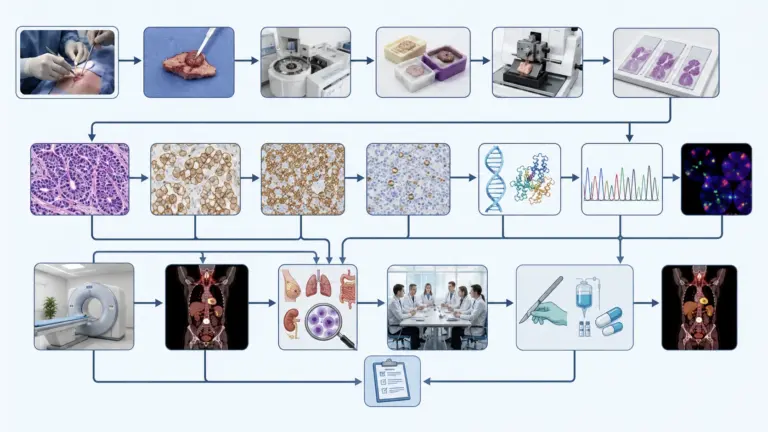
From Diagnosis to Recovery: How Does the Process Proceed?
- Initial Examination: In a patient presenting with hoarseness, swallowing difficulty, or a neck mass, a detailed history of smoking and alcohol use, occupational exposure, and family history is taken. An ENT specialist performs neck palpation and oral examination.
- Investigations: The vocal cords and larynx are directly visualised by fibreoptic laryngoscopy. A biopsy is taken from suspicious lesions. Tumour size and lymph node status are assessed by CT or MRI. Chest CT and PET-CT are used for distant metastasis screening.
- Treatment Plan: Surgery, radiotherapy, or chemoradiotherapy is planned in a multidisciplinary tumour board (ENT, medical oncology, radiation oncology) according to stage and location. A function-preserving approach is prioritised in early-stage disease.
- Surgical Process: Partial laryngectomy takes 24 hours and total laryngectomy 59 hours. A hospital stay of 57 days follows. Tracheostoma care, drain monitoring, and pain control are provided.
- Post-Discharge Recovery: Voice rehabilitation (electrolarynx, voice prosthesis, or oesophageal speech) begins within 24 weeks. Swallowing function improves within 26 weeks. Return to a normal diet is completed within 23 weeks, depending on the radiotherapy history. Return to work is possible 48 weeks later.
Frequently Asked Questions
Does laryngeal cancer cause pain?
Pain is rare in early-stage disease; the condition most commonly presents with hoarseness or difficulty swallowing. In advanced disease, particularly with supraglottic tumours, unilateral ear pain (referred pain) and neck pain may occur. The presence of pain generally suggests lymph node involvement or advanced-stage disease.
At what age does laryngeal cancer occur?
Laryngeal cancer most commonly occurs between the ages of 50 and 60. It is 5 times more common in men than in women. HPV-related cases can also be seen in young adults (under 40). Risk increases with age; those over 55 represent the highest-incidence group.
How does laryngeal cancer develop?
Squamous cells in the laryngeal mucosa undergo mutation after prolonged exposure to carcinogens such as tobacco, alcohol, or HPV. Cells grow uncontrollably, forming a tumour. In the glottic region it causes hoarseness by involving the vocal cords; in the supraglottic region it causes difficulty swallowing.
How is laryngeal cancer diagnosed?
Diagnosis is established by imaging with fibreoptic laryngoscopy and biopsy of a suspicious lesion. CT/MRI is used for staging, and PET-CT for metastasis screening. Squamous cell carcinoma is confirmed on pathology; HPV p16 testing may be performed.
How is laryngeal cancer detected?
If hoarseness lasting more than 2 weeks, persistent sore throat, unilateral ear pain, a neck mass, or weight loss are present, an ENT specialist should be consulted with suspicion of laryngeal cancer. Symptoms may be mild in early-stage disease; therefore those carrying risk factors should undergo regular check-ups.
Is laryngeal cancer treatable?
Yes, high treatment success can be achieved with radiotherapy or laser surgery in early-stage disease. Surgery, radiotherapy, and chemotherapy combinations are used in advanced disease. Immunotherapy (pembrolizumab) and targeted therapies (cetuximab) are available in recurrent/metastatic disease. The 5-year survival rate in localised disease is 79.8%.
What helps laryngeal cancer?
Treatment selection varies according to stage. Radiotherapy or surgery is used in early disease; chemoradiotherapy and surgery combinations in advanced disease. Stopping smoking and alcohol, healthy nutrition, vocal hygiene, and regular follow-up support treatment response. Pembrolizumab is an immunotherapy option in platinum-refractory disease.
Can laryngeal cancer be cured?
Complete remission is possible with radiotherapy or surgery in early-stage (T1T2) disease; the 5-year survival rate is 79.8%. In advanced-stage disease, treatment can bring the disease under control but the risk of recurrence is high. In recurrent disease, a second chance at treatment may be possible; total laryngectomy may be required in this situation.
Is laryngeal cancer fatal?
Prognosis is quite good in early-stage disease; the 5-year survival rate in localised disease is 79.8%. However, this rate falls to 36% in the presence of distant metastasis. Mortality can be significantly reduced with early diagnosis and appropriate treatment. Global laryngeal cancer mortality rates have declined over the past 30 years with the reduction in tobacco use.
Is laryngeal cancer contagious?
Laryngeal cancer itself is not contagious. However, HPV-16 infection can be transmitted sexually and can cause laryngeal cancer. The HPV vaccine (Gardasil 9) provides protection against both cervical and head and neck cancers. Risk is significantly reduced in individuals who do not smoke or consume alcohol.
Does laryngeal cancer recur?
The risk of recurrence varies according to stage and type of treatment. The 2-year recurrence rate is 16% in supraglottic tumours and 4% in glottic tumours. Recurrence after radiotherapy can be treated surgically (salvage laryngectomy). Regular follow-up (laryngoscopy at 36-month intervals) detects recurrence early.
Does laryngeal cancer metastasise?
Yes, supraglottic tumours metastasise to lymph nodes early due to their rich lymphatic drainage. Distant metastasis most commonly occurs to the lung (64.5%), liver (45%), and bone (25%). Systemic treatment (chemotherapy, immunotherapy) and supportive care are applied in metastatic disease.
How long does laryngeal cancer surgery take?
Partial laryngectomy takes 24 hours, and total laryngectomy 59 hours. Robot-assisted transoral surgery may take less time. Surgery duration varies according to tumour size, the need for lymph node dissection, and the history of previous radiotherapy.
Which department manages laryngeal cancer?
Ear, Nose, and Throat (ENT) specialists take the lead in diagnosis and treatment. Medical oncology (systemic treatment), radiation oncology (radiotherapy), pathology, and radiology are part of the multidisciplinary team. Medical oncology and immunotherapy specialists play an active role in recurrent/metastatic disease.
Laryngeal cancer is a malignancy that gives prominent symptoms such as hoarseness at an early stage and achieves high survival rates with appropriate treatment. The combination of smoking and alcohol is the most important risk factor; avoiding these risk factors provides primary prevention. Treatment must strike a balance between function preservation (voice and swallowing) and oncological control. Immunotherapy and targeted therapies offer new hope in recurrent/metastatic disease.
You can consult Assoc. Prof. Dr Nilay Şengül to evaluate your personal situation regarding laryngeal cancer and to have your questions answered. To book an appointment at Memorial Şişli Hospital, you can call 444 7 888.
References
- NIH/NCI SEER, Cancer Stat Facts: Laryngeal Cancer https://seer.cancer.gov/statfacts/html/laryn.html
- Yuan Y et al., PMC/NIH, 2025 “Tobacco and alcohol use are the risk factors responsible for the greatest burden of head and neck cancers: a study from the Global Burden of Disease Study 2019” https://pmc.ncbi.nlm.nih.gov/articles/PMC12051598/
- American Cancer Society, Cancer Facts & Figures 2025 https://www.cancer.org/…
- Cleveland Clinic, Laryngeal Cancer: Symptoms, Causes & Treatment https://my.clevelandclinic.org/health/diseases/16611-laryngeal-cancer
- NHS UK, Symptoms of laryngeal cancer https://www.nhs.uk/conditions/laryngeal-cancer/symptoms/