At a Glance
- Lip cancer is diagnosed in approximately 32,200 new cases worldwide each year; it is 2 times more common in men than in women.
- The 5-year survival rate in early-stage (T1T2) lip cancer is 8090%; as the stage advances, this rate falls to around 40%.
- Sun exposure is the leading cause of lower lip cancer, and when tobacco and alcohol are used together, the risk increases up to 15-fold.
- Surgical resection is the gold-standard treatment in early-stage disease; chemoradiotherapy combination is used in advanced-stage disease.
Lip cancer is a malignant tumour arising from the lip mucosa or vermilion region. According to GLOBOCAN 2022 data from the International Agency for Research on Cancer (IARC), part of the World Health Organisation, approximately 32,200 new cases of lip cancer are diagnosed worldwide each year, and 71.9% of these cases occur in men. Treatment success is high in patients diagnosed at an early stage.
What Is Lip Cancer?
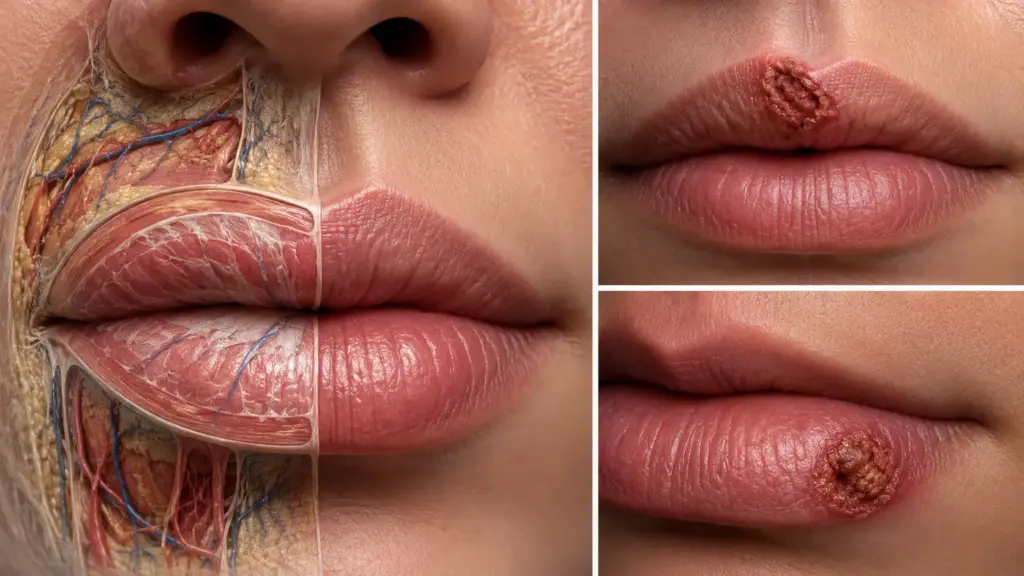
Lip cancer is a malignant neoplasm arising from lip tissue, most commonly appearing as squamous cell carcinoma (SCC). The lower lip is affected 1215 times more often than the upper lip; this is because the surface of the lower lip is exposed to more sunlight. Approximately 90% of lip cancer cases worldwide develop on the lower lip.
Lip cancer is a tumour group with a relatively good prognosis among head and neck cancers. The main reason for this is the high potential for early diagnosis, since the lesion is visible from the outside. However, when diagnosis is delayed, the risk of lymph node metastasis increases and prognosis is adversely affected.
According to Assoc. Prof. Dr Nilay Şengül, the most frequently missed point in the diagnosis of lip cancer is that patients view small sores or scabbing on the lip as “a simple aphthous ulcer” and delay visiting a doctor for a long time. In the cases we observe at Memorial Şişli Hospital, we emphasise that lip lesions lasting more than 3 weeks must be evaluated by biopsy.
What Causes Lip Cancer?
Many risk factors play a role in the development of lip cancer. These factors can be classified as modifiable and non-modifiable.
Principal Risk Factors
Ultraviolet (UV) radiation: Sun exposure is the most important cause of lower lip cancer in particular. The risk increases significantly in those who work outdoors, agricultural workers, and those who spend long periods in the sun. According to IARC data, UV radiation is classified as a Group 1 carcinogen.
Tobacco use: Smoking cigarettes, cigars, and pipes increases the risk of lip cancer. The incidence of lower lip cancer is particularly high in pipe smokers. Nicotine and tar in tobacco smoke cause DNA damage in lip epithelial cells.
Alcohol consumption: Excessive alcohol use acts synergistically with tobacco. According to CDC data, the risk of oral cancer in persons who use both tobacco and alcohol is approximately 15 times higher than in those who use neither.
Human papillomavirus (HPV): HPV type 16 is an important cause of head and neck cancers and is particularly associated with oropharyngeal cancers. Its role in lip cancer is less clear, but it may cause an increased risk in immunosuppressed patients.
Age and sex: Lip cancer most commonly occurs in people over 50. It is diagnosed 2 times more often in men than in women; this difference stems from men’s higher tobacco and alcohol use and sun exposure. However, a higher incidence has been reported in women for upper lip cancers; this is associated with cosmetic facial products and sun exposure.
| Risk Factor | Relative Risk Increase | Modifiable? |
|---|---|---|
| Sun exposure (UV) | High (leading cause on lower lip) | Yes |
| Tobacco use | ~510 times | Yes |
| Alcohol + tobacco combined | ~15 times | Yes |
| Advanced age (>50) | Increases with age | No |
| Male sex | ~2 times | No |
How Does Lip Cancer Develop?
Lip cancer develops through uncontrolled cell growth resulting from genetic mutations in epithelial cells. This process progresses slowly over years and generally begins with precursor lesions (pre-cancerous changes).
Leukoplakia: A precursor lesion appearing as white, non-removable plaques. It is seen in 15% of adults worldwide and increases the risk of SCC by 35 times.
Erythroplakia: Red, flat, sometimes painful lesions. They follow a more aggressive course than leukoplakia and the risk of malignant transformation is 5090%.
Lichen planus: Particularly the erosive type may predispose to lip cancer. It requires long-term follow-up.
Symptoms of Lip Cancer
The symptoms of lip cancer vary according to the location, size, and stage of the tumour. In early-stage disease, symptoms may be mild and easily overlooked by patients.
- A lip sore or ulcer lasting more than 3 weeks that does not heal
- Thickening, hardening, or a mass on the lip
- Colour change on the lip (white, red, or brown spots)
- Bleeding or scabbing
- Pain or burning sensation on the lip
- Swelling in the face or neck (enlarged lymph nodes)
- Restriction of lip movements (advanced stage)
Stages of Lip Cancer
Lip cancer staging is performed according to the American Joint Committee on Cancer (AJCC) 8th edition TNM system. This system evaluates tumour size (T), lymph node involvement (N), and distant metastasis (M) status.
| Stage | TNM Definition | 5-Year Survival |
|---|---|---|
| Stage I | T1 (2 cm, depth of invasion 5 mm), N0, M0 | 8590% |
| Stage II | T2 (>2 cm or depth of invasion >5 mm), N0, M0 | 7080% |
| Stage III | T3 or N1 (single lymph node 3 cm), M0 | 5060% |
| Stage IV | T4a/b or N2N3 or M1 | 3040% |
Treatment of Lip Cancer
Lip cancer treatment is individualised according to the tumour stage, site, the patient’s age, and comorbidities. Single-modality treatment is sufficient in early-stage disease, while combined treatment approaches are used in advanced-stage disease.
Surgical Treatment
Surgical resection is the gold-standard treatment in early-stage lip cancer. According to NCCN guidelines, surgery and radiotherapy yield similar survival outcomes in Stage T1T2, N0 lip cancers; however, most surgeons prefer surgery because functional and cosmetic results may be better.
Resection principles: The aim is to remove the tumour with a 510 mm margin of healthy tissue. In lower lip cancers, small lesions are closed with primary closure, while larger defects may require a V-Y advancement flap, Abbe-Estlander flap, or microvascular free tissue transfer (free flap).
Radiotherapy
Radiotherapy can be used as an alternative to surgery in early-stage lip cancer. According to NCCN guidelines, external radiotherapy or brachytherapy can be applied to T1T2, N0 lesions. Brachytherapy is an effective option particularly for small lower lip lesions.
Systemic Treatments
Chemoradiotherapy combination is used in advanced-stage (T3T4a) or metastatic lip cancer. According to NCCN guidelines, concurrent cisplatin-based chemoradiotherapy is the preferred regimen. Induction chemotherapy (TPF/TPF regimens) followed by radiotherapy or chemoradiotherapy options may be considered.
In recurrent/metastatic disease, immunotherapy agents (pembrolizumab, nivolumab) show efficacy in PD-L1-positive patients. Targeted therapies (cetuximab) can be used as an alternative in patients unsuitable for platinum.
Lip Cancer Surgery
Lip cancer surgery aims for complete removal of the tumour and preservation of lip function. The surgical technique is determined according to the size and location of the tumour.
Surgical Techniques
Small lesions (<1/3 of the lip): Full-thickness resection followed by primary closure or V-Y advancement flap reconstruction. This procedure can be performed under local anaesthesia and hospital stay is generally 1 day.
Medium-sized lesions (1/32/3 of the lip): Local flaps such as the Abbe-Estlander flap (cross-lip flap) or Karapandzic flap are used. These techniques preserve the oral aperture.
Large lesions (>2/3 of the lip): Microvascular free tissue transfer (radial forearm flap, anterolateral thigh flap) may be required. This procedure is performed under general anaesthesia and hospital stay is 35 days.
After Lip Cancer Surgery
Early period (first 2 weeks): Oedema and bruising at the wound site are normal. Oral hygiene is very important; chlorhexidine mouthwash is recommended. Liquid and soft-diet feeding is commenced. Sutures are generally removed on days 710.
Recovery process: Full recovery may take 46 weeks. Lip mobility, speech, and swallowing function improve gradually during this period. Assoc. Prof. Dr Şengül emphasises in clinical practice that functional exercises (lip movements, speech practice) starting at week 2 after surgery accelerate recovery.
Long-term follow-up: Controls are planned every 3 months for the first 2 years, then every 6 months for the following 3 years. At every check-up, lip examination and neck palpation are performed. Annual thyroid function tests (in patients who received radiotherapy) are recommended.
Clinical Assessment by Assoc. Prof. Dr Nilay Şengül
I frequently observe the following in clinical practice: The best treatment outcomes in lip cancer are achieved in cases where the patient takes small changes noticed in their own mouth seriously and presents at an early stage. Among the patients we follow at Memorial Şişli Hospital, we see that those who wait with a “it will pass” attitude for lip sores lasting more than 3 weeks are at a more advanced stage at the time of diagnosis.
According to Assoc. Prof. Dr Nilay Şengül, in patients diagnosed with lip cancer at an early stage, both cancer control and lip aesthetics and function can be preserved with conservative surgery. Particularly in lower lip lesions, excellent functional and cosmetic results can be achieved with local flaps following small resections. This approach increases the effectiveness of cancer treatment while preserving the patient’s quality of life.
From Diagnosis to Recovery: How Does the Process Proceed?
- Initial Examination and Assessment: The patient’s complaints, risk factors (tobacco, alcohol, sun exposure), and family history are questioned in detail. Assoc. Prof. Dr Şengül particularly emphasises asking at the first consultation how long the lesion on the lip has been present and its rate of growth. Physical examination involves palpation of the lip lesion’s size, borders, consistency, and neck lymph nodes.
- Investigations and Imaging: Biopsy (punch or incisional under local anaesthesia) is mandatory for diagnosis. Panoramic radiography for jaw bone invasion; CT or MRI for tumour depth, lymph node involvement, and distant metastasis screening; PET-CT for advanced-stage patients (T3T4).
- Staging and Treatment Planning: Staging is performed according to the AJCC 8th edition TNM system. An individualised treatment plan is created in a multidisciplinary tumour board (medical oncology, radiation oncology, plastic surgery, pathology, radiology). According to Assoc. Prof. Dr Nilay Şengül, decisions taken in this board optimise both oncological and functional outcomes for the patient.
- Surgery/Treatment: Early stage: resection under local or general anaesthesia (3090 minutes). Advanced stage: resection + neck dissection + reconstruction under general anaesthesia (25 hours). Adjuvant radiotherapy: 1 session per day, 5 days a week, 67 weeks in total.
- Hospital Stay and Discharge: Same-day discharge is possible for small resections. Hospital stay is 35 days for cases requiring major reconstruction. Oral care and dietary instructions are given upon discharge.
- Follow-up and Monitoring: Controls every 3 months for the first 2 years, every 6 months for the following 3 years. At each check-up, lip examination, neck palpation, and imaging when necessary. Thyroid function tests every 612 months in patients who received radiotherapy, because hypothyroidism may develop in 2025% of patients after neck radiation.
Frequently Asked Questions
What are the first signs of lip cancer?
The first signs of lip cancer include a lip sore that does not heal for more than 3 weeks, hardening or thickening of the lip, colour changes (white, red, or brown spots), and mild bleeding. Pain is rare in early-stage disease; therefore patients may not notice the lesion. Any change on the lip that does not resolve within 23 weeks should prompt a visit to a doctor.
How is lip cancer detected?
Definitive diagnosis is established by biopsy. In clinical examination, however, the doctor evaluates the size, borders, consistency of the lesion, and the neck lymph nodes. Panoramic radiography shows jaw bone involvement; CT/MRI shows tumour depth and lymph node status. PET-CT is used for distant metastasis screening in advanced-stage patients.
How does lip cancer begin?
Lip cancer generally begins with precursor lesions. Leukoplakia (white plaque) is the most common precursor lesion and the risk of malignant transformation is 35%. Erythroplakia (red lesion) is more aggressive and the risk of malignant transformation is 5090%. Progression from these lesions to cancer advances slowly over years. UV exposure, tobacco, and alcohol accelerate this process.
Can lip cancer be cured?
In lip cancer diagnosed at an early stage (Stage III), the 5-year survival rate after surgery is 8090%. This rate declines as the stage advances; it drops to 5060% at Stage III and 3040% at Stage IV. The risk of recurrence is highest in the first 2 years. Regular follow-up and avoidance of risk factors (sun protection, stopping tobacco) are important.
Lip cancer is a head and neck cancer in which high survival rates can be achieved with early diagnosis and appropriate treatment. Lower lip cancer is particularly associated with sun exposure and can be prevented with protective measures (lip balm with sunscreen, wide-brimmed hat). Surgical resection in early-stage disease ensures both cancer control and preservation of lip function. Multimodal treatment approaches are used in advanced-stage disease.
You can consult Assoc. Prof. Dr Nilay Şengül to evaluate your personal situation regarding lip cancer and to have your questions answered. To book an appointment at Memorial Şişli Hospital, you can call 444 7 888.
References
- Bray F et al., CA Cancer J Clin. 2024;74(3):229-263 https://doi.org/10.3322/caac.21834
- IARC GLOBOCAN 2022 Lip, Oral Cavity Cancer Fact Sheet
- NCCN Guidelines Version 1.2026 Head and Neck Cancers https://www.nccn.org/…
- CDC Oral Cancer Risk Factors https://www.cdc.gov/…